Jon Huntsman Jr. Quotes
This race has degenerated into an onslaught of negative and personal attacks, not worthy of the American people and not worthy of this critical time in our nation’s history.
He was the only candidate who was not visciously attacked and slandered by the others, and he did no attacking himself. However, he simply did not attract the voters as did the other candidates who were so negative about their opponents. The Republican party primary voters were so insistent on political party purity that most of the candidates were reduced to the lowest forms of debate and standards of veracity. All the candidates were weakened and diminished by that form of negative primary process. Mitt Romney finally won the nomination but had been bruised badly by the Republican primary election. He last the general election badly.
Jon Huntsman, Jr., Governor of Utah (Republican), U. S. Ambassador to China, Unsuccessful candidate for the Republican Nomination for President, Statement upon withdrawing from the race for the Republican Presidential Nominee, January 16, 2012
Sourced by: Eigen's Political and Historical Quotations

At that time, most of the leading Republicans practiced negative campaigning with vicious personal attacks that were often untrue. He was the only one of the 9 candidates who did not engage in the technique. He came in close to last.


35 years earlier Vice President Hubert Humphrey used the same phrase to describe Republican attacks.


The text was actually written by John Kenneth Galbraith who was writing speeches for Stevenson.

There have been few modern politicians who would be so firm against negative campaigning by members of his own party. In reality, although Roosevelt was very popular amongst the people, he was never a favorite of the party politicians. For example, see {585078}.
At the time political parties and some candidates had their own newspapers and attacked their opponents through those rather than directly themselves which would have been seen as gross and undignified, Slander and attacks have been a part of American politics since its inception. The degree and extent reached its pinnacle in the early 21st century.


Some Democrats had been making personal attacks on Herbert Hoover, Baruch a Democratic supporter was outraged and put a stop to much of it. His letter to Hoover is the high water mark in the ethics and methods of Presidential campaigning. 80 years later, there was a Republican Presidential Nomination contest in which there was almost no content other than personal attacks on the other candidates interspersed with personal attacks on the incumbent President. It was one of the low points of Presidential campaigning.


35 years later Richard Gephardt used the same phrase to describe Republican tactics.

Personal attacks have been made in the Congress ever since that body first met. However, they were infrequent and raised concern when they were made. However, in the late 1980s, there was a series of personal attacks made across the political parties culminating in the resignation of Wright as the Speaker of the House. Some Republicans had objected to the failure to confirm John Tower as Defense Secretary because of his serious alcoholism problem which was made public, and in turn made public some of Wright’s indiscretions. From then on the personal invective and attacks increases and there was retaliation by both parties that went on for decades. At first it was exposures of real incidents but by the 21st century, the attacks were often fabricated. For example, Barack Obama was called a “Socialist Muslim” by Republicans. See {624107}

In 2011 and 2012, there were several candidates vying for the Republican Nomination for the Presidency. The contest was close, and the candidates unleashed on each other the negative advertising and outrageously false accusations which they had previously only reserved to attack Democrats. They were so good at it, that they all drove up each others’ negatives—so much so that the potential Republican Candidate would be permanently scarred in the minds of the public. More mature and senior Republicans like McCain urged an end to the face to face confrontations of debates.

Amis did not get the quotation exactly right but it was close enough for his analysis. For the actual quotation, see {631016}.

His older brother was running for Consul—the highest elected office of the Roman Empire. The Handbook, was his advice to his brother as to how to conduct his campaign.


He delivered this speech towards the end of the 1st year of President Donals Trump's Administration. Althought he never mentioned Trump by name, this speech was a rare major criticism of a sitting president by a former president. This was also one of the few speeches Bush gave after leaving office. On the same day, former President Barak Obama also gave a major speech and also castigated President Trump although neither of the ex-presidents knew that the other was about to deliver their criticism of Trump. It was one of the very unusal occurances in American history.


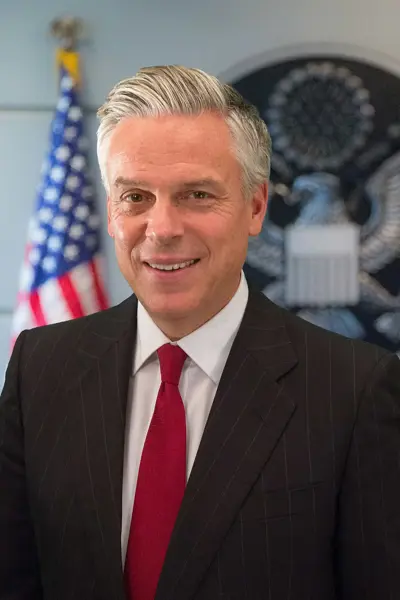
Jon Meade Huntsman Jr. is an American businessman, diplomat and politician who served as the 16th Governor of Utah from 2005 to 2009. A member of the Republican Party, he served as the Ambassador of the United States to Russia from 2017 to 2019, to China from 2009 to 2011, and to Singapore from 1992 to 1993.
