H. R. Haldeman Quotes
The president does not like you to take an opposite view at a cabinet meeting, or say anything that can be construed to be mildly not in accord with his thinking.
This quotation illustrates one of Nixon’s major character flows. He was so insecure that he could not tolerate any of his “team” disagreeing in the slightest. It is expected that when an issue is decided by the president, the VP and the cabinet support that, but at the cabinet meeting the President is supposed to be getting advice.
H. R. Haldeman, 1926-1993, White House Chief of Staff (Republican), Instructions to Vice President Spiro Agnew, 1918-1996, Spiro Agnew, Go Quietly or Else
Sourced by: Eigen's Political and Historical Quotations


Goldsmith headed the Justice Department Office of Legal Counsel—the office that makes legal opinions to guide the Federal Government’s conduct. Goldstein had been asked to render an opinion as to whether terrorists captured in the Iraq War were protected by the Geneva Conventions. The Justice Department staff had concluded that all Iraq civilians were covered including terrorists and insurgents. He was called to meeting at the White House with the President’s and Vice President’s counsels. When Goldsmith revealed the Justice Department conclusion, Addington grew agitated and made this response. The quotation provides insight into the operations of the George W. Bush White House and its relationship with the rest of the government.

Some people get upset when they learn that members of the President’s cabinet disagreed with the president on a major policy. Yet this is very common and very desirable as long as when the President reaches his/her decision, the dissenters all close ranks and implement it. Some Presidents are not secure enough or confident enough to be comfortable with dissent. The greatest of our Presidents were known for their selection of strong advisors who have different perspectives. President Lincoln had all his rivals for the Presidency in his cabinet. Franklin Roosevelt appointed a number of Republicans to his cabinet and a left wing socialist also. Theodore Roosevelt’s Secretary of State, Elihu Root, was famous for telling the President where Root thought he was wrong. George Washington had Thomas Jefferson and Alexander Hamilton in his cabinet and they fought like cats and dogs. Jefferson ran against Washington’s Federalist party and destroyed that party at the polls. However, the nation was better for these brilliant, experienced cabinet members helping a strong President to make consider all possibilities and make better decisions.


Thereafter Ball argued against the Vietnam War at every staff meeting where it was discussed. The President never cut him off. With the exception of Chief of Staff Marvin Watson, none of the other staff members realized that Ball was following the directions of the President, and tended to be annoyed with him for constantly opposing the war.


Mary Lincoln went to many séances in an attempt to resolve her feelings about her dead son. The President attended at least one.


Mary Lincoln, grieving for her dead son, organized many seances in a desperate attempt to be reunited with her dead son. The President to comfort her attended a few. :Later he made this quip to friends.


The only soldier ever so honored. Marshall was then the Deputy Chief of Staff of the Army. The President was meeting with the Army leadership to plan the nation’s preparedness to come with the Nazi menace. Army brass had wanted to build up large ground forces. However, conservatives (in those days opposed to military spending) accused the Roosevelt administration of fomenting war. FDR wanted to be less visible and opted for a program that would build 7 aircraft factories first and later build ground forces. He asked if all agreed and the army heads all bobbed except for Marshall, then a relatively junior general. FDR never forgot the one general who told him, No, and when War was eminent, he selected Marshall lead the military and promoted him over 34 more senior generals. Great leaders appreciate people who have the courage and integrity to say No to power and FDR had the confidence in himself that he could handle people who disagreed or were difficult. This was one of FDR’s many great appointments.

5th Marquis of Lansdowne. Nicholas II was very indecisive and was very easily persuadable.


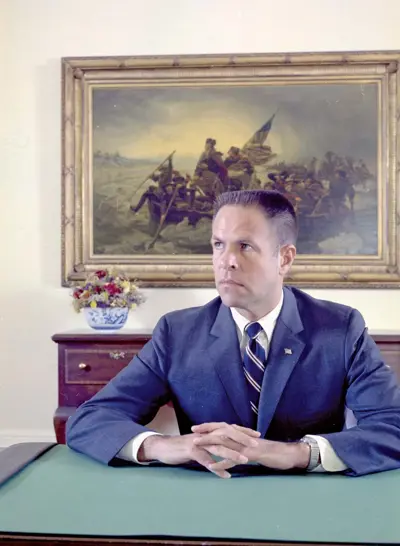
Harry Robbins "Bob" Haldeman was an American political aide and businessman, best known for his service as White House Chief of Staff to President Richard Nixon and his consequent involvement in the Watergate scandal.
