George C. Marshall Quotes
I am sorry Mr. President, but I don’t agree with that at all!
The only soldier ever so honored. Marshall was then the Deputy Chief of Staff of the Army. The President was meeting with the Army leadership to plan the nation’s preparedness to come with the Nazi menace. Army brass had wanted to build up large ground forces. However, conservatives (in those days opposed to military spending) accused the Roosevelt administration of fomenting war. FDR wanted to be less visible and opted for a program that would build 7 aircraft factories first and later build ground forces. He asked if all agreed and the army heads all bobbed except for Marshall, then a relatively junior general. FDR never forgot the one general who told him, No, and when War was eminent, he selected Marshall lead the military and promoted him over 34 more senior generals. Great leaders appreciate people who have the courage and integrity to say No to power and FDR had the confidence in himself that he could handle people who disagreed or were difficult. This was one of FDR’s many great appointments.
George C. Marshall, 1880-1959, General & U. S. Army Chief of Staff, U. S. Secretary of State, U. S. Secretary of Defense, Nobel Peace Prize Winner Statement to President Franklin Delano Roosevelt, 1938
Sourced by: Eigen's Political and Historical Quotations

The ride was the 1933 inaugural where the outgoing President rode down Pennsylvania Avenue with his successor. Roosevelt had tried to engage Hoover in conversation and Hoover refused. For years after that FDR used to tell the story and would imitate Hoover with grunts and facial contortions.


In the early 1970's Congress began to assert itself in foreign policy. An amendment was proposed by Mike Mansfield to halve the troops committed to NATO:


A decision George F. Kennan had advocted had backfired and the administration was being castigated in the press. Kennan apologized to the Secretary of State. The only soldier ever so honored


Some people get upset when they learn that members of the President’s cabinet disagreed with the president on a major policy. Yet this is very common and very desirable as long as when the President reaches his/her decision, the dissenters all close ranks and implement it. Some Presidents are not secure enough or confident enough to be comfortable with dissent. The greatest of our Presidents were known for their selection of strong advisors who have different perspectives. President Lincoln had all his rivals for the Presidency in his cabinet. Franklin Roosevelt appointed a number of Republicans to his cabinet and a left wing socialist also. Theodore Roosevelt’s Secretary of State, Elihu Root, was famous for telling the President where Root thought he was wrong. George Washington had Thomas Jefferson and Alexander Hamilton in his cabinet and they fought like cats and dogs. Jefferson ran against Washington’s Federalist party and destroyed that party at the polls. However, the nation was better for these brilliant, experienced cabinet members helping a strong President to make consider all possibilities and make better decisions.


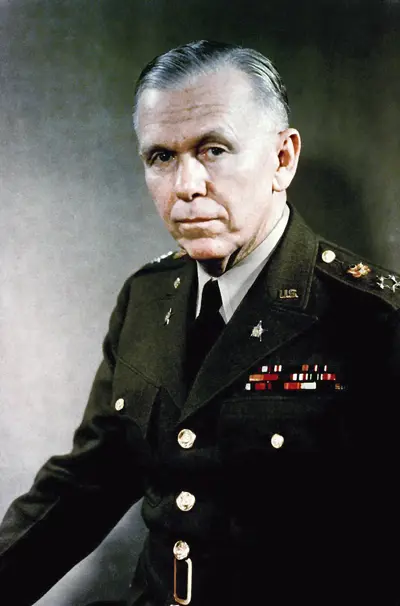
George Catlett Marshall Jr. was an American soldier and statesman. He rose through the United States Army to become Chief of Staff under presidents Franklin D. Roosevelt and Harry S. Truman, then served as Secretary of State and Secretary of Defense under Truman. Winston Churchill lauded Marshall as the "organizer of victory" for his leadership of the Allied victory in World War II. After the war, he spent a frustrating year trying and failing to avoid the impending civil war in China. As Secretary of State, Marshall advocated a U.S. economic and political commitment to post-war European recovery, including the Marshall Plan that bore his name. In recognition of this work, he was awarded the Nobel Peace Prize in 1953.
