George C. Marshall Quotes
The decision had my approval; it was discussed in the cabinet; it was approved by the President. The only trouble with you is that you don't have the perspicacity of a columnist. Now get out of here.
A decision George F. Kennan had advocted had backfired and the administration was being castigated in the press. Kennan apologized to the Secretary of State. The only soldier ever so honored
George C. Marshall, 1880-1959, General & U. S. Army Chief of Staff, U. S. Secretary of State, U. S. Secretary of Defense, Nobel Peace Prize Winner Remark to George F. Kennan
Sourced by: Eigen's Political and Historical Quotations


This is the earliest use of the “pass the buck” phrase in politics that we have found. The term originated in gambling. In a poker game, the “buck” was a physical object token that would be passed from player to player to indicate who was to deal.

President Roosevelt was on an extended Western trip and had left Taft in charge of the Government as a type of “Acting President”—See {639910} and {640479}. However, many issues were arising including foreign policy problems that had to be handled. Taft was unsure of his authority, but Roosevelt in his own inimitable style assured him with this quotation. No other President since has delegated this much authority to anyone for the operation of the government. With modern communications, it is doubtful that any president will ever do so again.


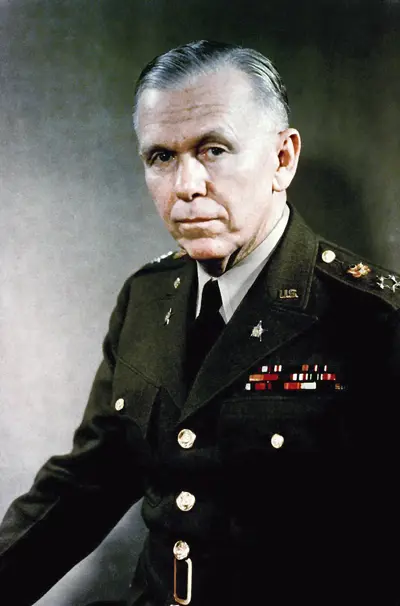
George Catlett Marshall Jr. was an American soldier and statesman. He rose through the United States Army to become Chief of Staff under presidents Franklin D. Roosevelt and Harry S. Truman, then served as Secretary of State and Secretary of Defense under Truman. Winston Churchill lauded Marshall as the "organizer of victory" for his leadership of the Allied victory in World War II. After the war, he spent a frustrating year trying and failing to avoid the impending civil war in China. As Secretary of State, Marshall advocated a U.S. economic and political commitment to post-war European recovery, including the Marshall Plan that bore his name. In recognition of this work, he was awarded the Nobel Peace Prize in 1953.
