Curtis LeMay Quotes
If you kill enough of them, they stop fighting.

See Prince Otto von Bismarck-Schoenhausen {632620} for a similar focus on "iron and blood". This is no coincidence as Lindemann had been the Captain of the Battleship Bismarck.


Most were tracked down and assassinated by Israeli agents. The mastermind, Abu Daud was seriously wounded but was not attacked again when the Israeli’s and Palestinians began their peace negotiations.


Lev Davidovich Bronstein

Prior to whites settling in America, various Indian tribes had a long history of fierce fighting for control of Kentucky. The Transylvania Land company negotiated for the “rights” to Kentucky. Dragging Canoe, who opposed the treaty, argued that the land had a bad history and would be very difficult to settle. Poet Theodore O’Hara described Kentuckians as “Sons of the Dark and Bloody Ground” in his poem, The Bivouac of the Dead.


He was ironically observing that most animals and primitive humans, there is fighting among the species but rarely do the fight to the death. One usually gives up, and the other will let him retire from the fight. The fighter who is getting the worst of it, will retire from the battle. However, “civilized” humans will fight for principles and ideas often to the death. “Civilized humans” also think ahead and will strive to exterminate an enemy and kill even after surrender or submission.


In this case, he was referring to the situation with the Barbary Pirates who had an incredible extortion racket going in the Mediterranean. If nations would pay them an annual sum each year, they would not attack and seize merchant ships of that country and sell the ships and goods while holding the sailors for ransom. Jefferson favored and authorized war—a naval attack which for many reasons the European nations had not done (they just paid the tribute). Then a peace treaty was finally signed—the first American Treaty.

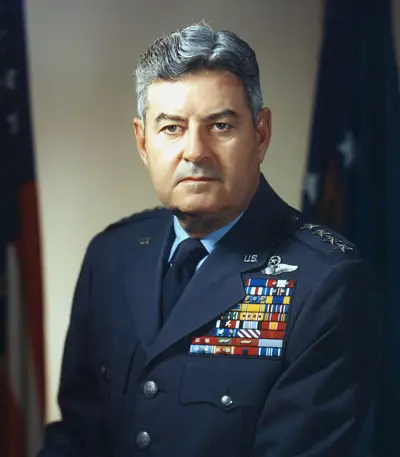
LeMay became a pursuit pilot and, while stationed in Hawaii, became one of the first members of the Air Corps to receive specialized training in aerial navigation. In August 1937, as navigator under pilot and commander Caleb V. Haynes on a Boeing B-17 Flying Fortress, he helped locate the battleship Utah despite being given the wrong coordinates by Navy personnel, in exercises held in misty conditions off California, after which the group of B-17s bombed it with water bombs. For Haynes again, in May 1938 he navigated three B-17s 620 nm (610 miles or 980 km) over the Atlantic Ocean to intercept the Italian liner SS Rex to illustrate the ability of land-based airpower to defend the American coasts. In 1940 he was navigator for Haynes on the prototype Boeing XB-15 heavy bomber, flying a survey from Panama over the Galapagos islands. War brought rapid promotion and increased responsibility.
