McGeorge Bundy Quotes
Our best chance of success is a policy of sustained reprisal against North Vietnam. We believe the risks of such a policy are real but acceptable. Measured against the cost of defeat, this program seems cheap.
Up to that time U. S. policy was to provide training and assistance to the South Vietnamese government and military, but not to attack the North. America had backed a corrupt and incompetent South Vietnamese government and Bundy and other policy makers were convinced that the North Vietnam would win, if the fighting and governing were solely left to the South Vietnamese. Johnson, who had resisted this policy for several weeks finally acceded. It was a major escalation of the Vietnam War.
McGeorge Bundy, 1919-1996, Presidential Assistant for National Security (Democrat), Cable to President Lyndon Johnson after North Vietnam had first attacked Americans in the South, November 1968
Sourced by: Eigen's Political and Historical Quotations


The War Plan that the Germans had developed--{642092}—had gone awry at the battle of the Marne in late 1914.

War and international conflict had become very complicated in modern times. Americans and most other people associated victory in war with unconditional surrender. However, since the unconditional surrender is of WWII, no conflict has ended with an unconditional surrender.

Chomsky was not asserting this statement as the truth. He was making the statement assuming that the absurdity of it would be clear to the listener and they would also realize that was what the then government policy was. North Vietnamese had infiltrated the South and had much support in many of the South Vietnamese villages. When the U. S. bombed the North Vietnamese—and the Vietnamese inhabitants—of those villages, the intention was indeed to help the South Vietnamese. If Chomsky were a politician running for office, his opponent might well have taken this quote and used it to “prove” that Chomsky supported the American effort in the Vietnam War when he was a vehement opponent.


Boggs was working on some compromise positions that could be taken by the party at the 1968 Democratic National Convention to provide the anti war wing of the party with something. The President found out and met with Congressman Boggs.


This was only 10 months into Nixon's Presidency. He stepped up the war.


The occasion was the visit to Washington of French Minister M. Jean Letourneau. The French were fighting the communists in Vietnam and the U. S., not yet in the fight, promised material and political aid, but no military participation. It was almost a decade later that America sent its first military personnel to Vietnam. The West was persuaded that the French could handle the situation. When they were defeated, America and Britain assumed that it was the notorious military incompetence of the French that accounted for the situation rather than the competence and commitment of the Vietnamese Communists and their support of the majority of the people.


sending American troops to Vietnam


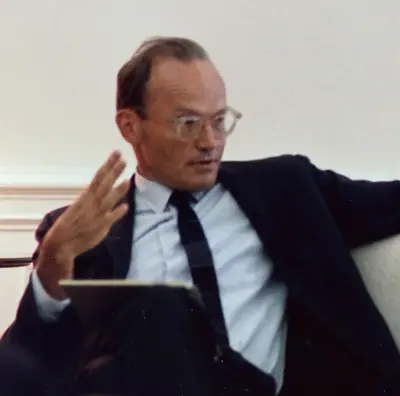
McGeorge "Mac" Bundy was an American academic who served as United States National Security Advisor to Presidents John F. Kennedy and Lyndon B. Johnson from 1961 through 1966. He was president of the Ford Foundation from 1966 through 1979. Despite his career as a foreign-policy intellectual, educator, and philanthropist, he is best remembered as one of the chief architects of the United States' escalation of the Vietnam War during the Kennedy and Johnson administrations.
