Lyndon B. Johnson Quotes
Our purpose in Vietnam is to prevent the success of aggression. It is not conquest, it is not empire, it is not foreign bases, it is not domination. It is, simply put, just to prevent the forceful conquest of South Vietnam by North Vietnam.
Johnson, Lyndon B. Public Papers of the Presidents of the United States: Lyndon B. Johnson, 1965, Book I. United States Government Printing Office, 1966, p. 395.


Chomsky was not asserting this statement as the truth. He was making the statement assuming that the absurdity of it would be clear to the listener and they would also realize that was what the then government policy was. North Vietnamese had infiltrated the South and had much support in many of the South Vietnamese villages. When the U. S. bombed the North Vietnamese—and the Vietnamese inhabitants—of those villages, the intention was indeed to help the South Vietnamese. If Chomsky were a politician running for office, his opponent might well have taken this quote and used it to “prove” that Chomsky supported the American effort in the Vietnam War when he was a vehement opponent.


Up to that time U. S. policy was to provide training and assistance to the South Vietnamese government and military, but not to attack the North. America had backed a corrupt and incompetent South Vietnamese government and Bundy and other policy makers were convinced that the North Vietnam would win, if the fighting and governing were solely left to the South Vietnamese. Johnson, who had resisted this policy for several weeks finally acceded. It was a major escalation of the Vietnam War.


Most Americans had not then realized that American troops had gotten involved in the Vietnamese Civil War. For some this was shocking. Kennedy helped his brother, President Kennedy, arrange for a coup to replace President Ngo Dinh Diem in which the man we pledged to “stand by” was murdered. He turned out to be thoroughly corrupt, and had little if any more respect for democracy and human rights than the North Vietnamese leadership did. Nonetheless we broke a pledge to an ally. This and similar promises that are not kept complicates American diplomacy as there is rarely complete trust in the pledges of American officials.

Ford was then a member of Congress. This was known as the “Domino Theory” and was the strategic reason that sending troops to Vietnam was in America’s vital Interest. However, the Domino Theory was incorrect. Vietnam did fall to the Communists, and yet NONE of the countries became communist. Actually, they became even more democratic.
Later, when he ran for the Democratic Presidential Nomination had had changed his mind and was a major opponent of the Vietnam War. This was the pattern of so many Americans whose first instinct was to support the government’s decision to wage war, and over time grew disenchanted with the war and ended up opposing the war actively.


sending American troops to Vietnam
After the French were driven out, Vietnam was supposed to have a national election to choose a government but the people of Vietnam were deeply split between those supporting the Communists and Ho Chi Min (who had led the campaign to oust the French from their colony) on one side and Vietnamese who were more Westernized and favored a democracy. Vietnam was mostly Buddhist but most of the Western oriented leadership of the Democracy advocates were Christians. They wanted to delay the election to give them a chance to organize to catch up with the communists at political organization. Ho Chi Min and the Communists already do facto controlled the North of Vietnam and decided to use force against the Western oriented forces whose military was much smaller than the Communists who had ejected the French. The United States provided financial aid and supplied weapons and Central Intelligence Agency assistance to the South Vietnam forces who were afraid of being overrun by the Communists headquartered in the North. Taylor’s mission was to go to Vietnam, assess the situation and make recommendations to President Kennedy.


When U.S. Ambassador-at-Large Harriman asserted that there were 40,000 North Vietnamese troops in Laos, Xuan Thoy, the leader of the Communist delegation at the Paris peace talks, denied the charge vigorously. Harriman replied:

President Johnson had invited Ike to the White House to advise about the Vietnam War in general and the Rolling Thunder operation in particular. President Eisenhower’s quotation was one of the clearest statements of the so-called Domino Theory which was believed by almost all American Military and Foreign Policy leaders. It was tragically wrong, but it drove U. S. policy throughout the war. When the Communists took South Vietnam, there was no subsequent Communist takeover or attempt in any of the countries Eisenhower had enumerated. One of the reasons was that the Vietnam Communists were not very close to the Russians and for over 1000 years had considered China their worst enemy. They had little solidarity with the International communist movement, but American intelligence did not realize that. They did not believe that the ethnic hatred between Vietnam and China would inhibit the Vietnamese in modern times. It did. Even after the war, the Vietnamese developed better relations with the U. S. then they had with China. One of the major things the intelligence and policy operators missed was that there was not a single map in China that showed Vietnam as a country. To the Chinese, it has always been a part of China and they want it to be in the future. The Vietnamese have not agreed for a millennium.
The reference to Munich referred to British Prime Minister meeting with Adolf Hitler in Munich, giving Germany some of their demands while receiving assurances that there would be no further aggression. This appeasement just encouraged Hitler to take more and soon he had invaded all of Europe beginning World War II. The view since has been that a dictator must never be appeased in unjust aggression, even on relatively small items. What made the Vietnam War so complicated was that while it appeared that the attacks on South Vietnam by Communist North Vietnam was a first step of general Communist Aggression, the reality was that it was primarily a Civil War where the South was a massively corrupt, Catholic Controlled dictatorship and the North was a Communist dictatorship dominated by Buddhists. And there was major friction between the Vietnamese Communists and the Chinese Communists who were not working in concert for general Communist domination. The North Vietnamese were a nationalist movement. The Domino Theory had been wrong.
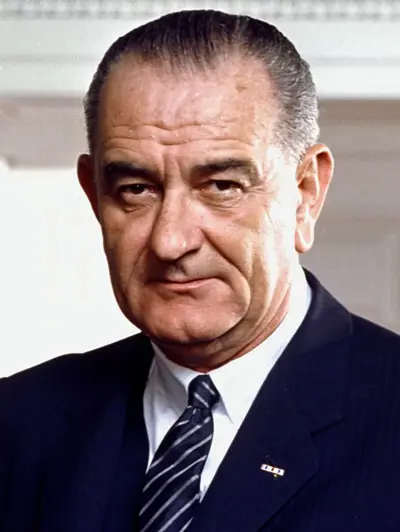
Lyndon Baines Johnson, often referred to by his initials LBJ, was the 36th president of the United States, in office from 1963 to 1969. He served as the 37th vice president from 1961 to 1963 and assumed the presidency following the assassination of President John F. Kennedy. A Democrat from Texas, Johnson was also a United States representative and later majority leader in the United States Senate. Johnson is one of only four people to have served, at various times, in all four federal elected positions.
