Maxwell D. Taylor Quotes
I don't recall anyone who was strongly against except one man, and that was the President [JFK]. The President just didn't want to be convinced that this was the right thing to do.... It was really the President's personal conviction that U.S. ground troops shouldn't go in.
sending American troops to Vietnam
Maxwell D. Taylor,1901-1987 Army General & Chief of Staff, Chairman of the Joint Chiefs of Staff, U. S. Ambassador to South Vietnam, Superintendent of West Point, Chairman of Bay of Pigs Investigation Team, President and Chairman of the Foreign Intelligence Advisory Board, President of the Institute for Defense Analyses, Quoted in Arthur Schlesinger, Robert Kennedy: His Life and Times
Sourced by: Eigen's Political and Historical Quotations

After the French were driven out, Vietnam was supposed to have a national election to choose a government but the people of Vietnam were deeply split between those supporting the Communists and Ho Chi Min (who had led the campaign to oust the French from their colony) on one side and Vietnamese who were more Westernized and favored a democracy. Vietnam was mostly Buddhist but most of the Western oriented leadership of the Democracy advocates were Christians. They wanted to delay the election to give them a chance to organize to catch up with the communists at political organization. Ho Chi Min and the Communists already do facto controlled the North of Vietnam and decided to use force against the Western oriented forces whose military was much smaller than the Communists who had ejected the French. The United States provided financial aid and supplied weapons and Central Intelligence Agency assistance to the South Vietnam forces who were afraid of being overrun by the Communists headquartered in the North. Taylor’s mission was to go to Vietnam, assess the situation and make recommendations to President Kennedy.


He served Presidents Reagan, Clinton, and both Bushes


Podharetz was citing the Vietnam war. The two American occasions where the plausibility seemed to fade were the Vietnam War and The Irag war. Both Presidents Lyndon Baines Johnson and George W. Bush as Bismarck predicted, had much political trouble over the wars.

Most Americans had not then realized that American troops had gotten involved in the Vietnamese Civil War. For some this was shocking. Kennedy helped his brother, President Kennedy, arrange for a coup to replace President Ngo Dinh Diem in which the man we pledged to “stand by” was murdered. He turned out to be thoroughly corrupt, and had little if any more respect for democracy and human rights than the North Vietnamese leadership did. Nonetheless we broke a pledge to an ally. This and similar promises that are not kept complicates American diplomacy as there is rarely complete trust in the pledges of American officials.


Chomsky was not asserting this statement as the truth. He was making the statement assuming that the absurdity of it would be clear to the listener and they would also realize that was what the then government policy was. North Vietnamese had infiltrated the South and had much support in many of the South Vietnamese villages. When the U. S. bombed the North Vietnamese—and the Vietnamese inhabitants—of those villages, the intention was indeed to help the South Vietnamese. If Chomsky were a politician running for office, his opponent might well have taken this quote and used it to “prove” that Chomsky supported the American effort in the Vietnam War when he was a vehement opponent.


Four years later the President embarked on a nation-building effort in Iraq which was beset with many problems.


The U. S. was evacuating all its forces and agents as the Viet Cong overran Saigon. This ended the Vietnam War. The CIA, had been telling the President and the National Security Staff that the Army reports were exaggerated and we were not faring well in the Vietnam War. Events proved them right. Their earlier track record, especially with President Nixon was very poor in intelligence analysis and prediction. See {634511}, {634509}, and {634503} for Nixon’s view of the CIA.

Barry Goldwater in the 20th century used a variation of this quotation. See {601784}.

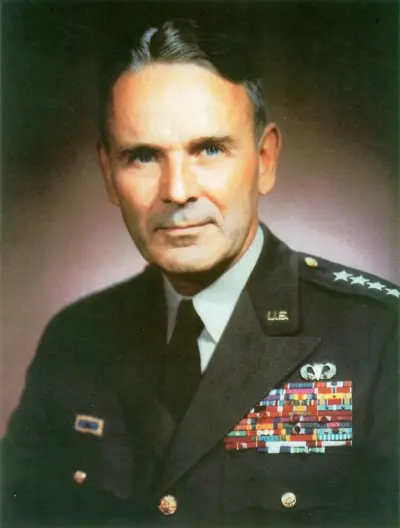
Maxwell Davenport Taylor was a senior United States Army officer and diplomat of the mid-20th century. He served with distinction in World War II, most notably as commander of the 101st Airborne Division, nicknamed "The Screaming Eagles."
