Robert M. Gates Quotes
Any future Defense Secretary who advises the President to again send a big American land army into Asia or into the Middle East or Africa should have his head examined.
Robert M. Gates, Director, Central Intelligence Agency, U. S. Secretary of Defense Statement just before he finished his term, July 2011
Sourced by: Eigen's Political and Historical Quotations


3 years later he led America on a huge invasion and nation building project in Iraq. It turned out that had he listened to his own advice and not flip-flopped, the huge cost of the Iraq War might have been avoided.


See {633152} for more of the reasoning for this point. “Neocon” is a shortened form of “neoconservative”. At the time the neoconservatives were advocating use of military intervention in the Middle East. Munich was the German city in which British Prime Minister notoriously tried to appease Hitler and the Nazis. This led to WWII and has become the historical icon for appeasement of a powerful tyrant and the cost of such.
Four years later the President embarked on a nation-building effort in Iraq which was beset with many problems.

The Vietnam War was certainly not a victory for the U. S. Some saw it as our first defeat. While it was not ended on Johnson’s watch, he must certainly share that responsibility with Nixon and even JFK as these three all were responsible for our Vietnam failure. Johnson, ended up with what he feared most.


He served Presidents Reagan, Clinton, and both Bushes


Every major Western power and Japan were looking to control parts of China for their own mercantile advantage. The Emperor, her adopted son, had stated that under no circumstances would the Chinese fight, but Cixi issued this decree, in effect, overruling the Emperor—a remarkable occurrence.

There were many who thought that the Russians would view the Mutual Security Act as aggressive and they might respond with some kind of aggressive retaliation and this could lead to war. Others felt that containment would reduce the likelihood of war.

That was an ironic statement. Shortly thereafter we invaded Mexico, occupied the country, pressured it into “selling us much of what is now the Southwest of the United States, and finally left.


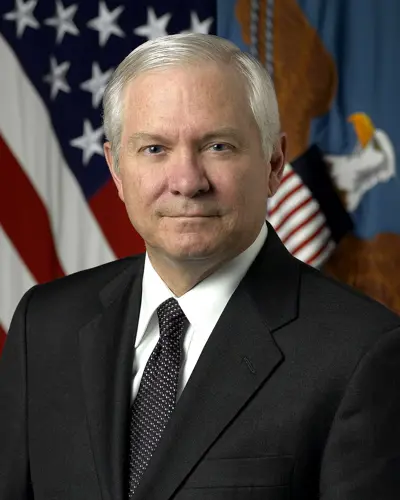
Robert Michael Gates is an American intelligence analyst, and university president who served as the 22nd United States secretary of defense from 2006 to 2011. He was originally appointed by President George W. Bush and was retained for service by President Barack Obama. Gates began his career serving as an officer in the United States Air Force but was quickly recruited by the Central Intelligence Agency (CIA). Gates served for 26 years in the CIA and the National Security Council, and was Director of Central Intelligence under President George H. W. Bush. After leaving the CIA, Gates became president of Texas A&M University and was a member of several corporate boards. Gates served as a member of the Iraq Study Group, the bipartisan commission co-chaired by James A. Baker III and Lee H. Hamilton, that studied the lessons of the Iraq War.
