David Lloyd George Quotes
There never was a greater contrast, mental or spiritual, than that which existed between these two notable men. Wilson with his high but narrow brow, his fine head with its elevated crown and his dreamy but untrustful eye -- the make-up of the idealist who is also something of an egoist; Clemenceau, with a powerful head and the square brow of the logician - the head conspicuously flat topped, with no upper story in which to lodge the humanities, the ever vigilant and fierce eye of the animal who has hunted and been hunted all his life. The idealist amused him so long as he did not insist on incorporating his dreams in a Treaty which Clemenceau had to sign.
1st Earl Lloyd-George of Dwyfor
David Lloyd George, 1863-1945, British Prime Minister (Liberal), Describing the Treaty of Versailles Negotiations in 1919, The Truth About the Peace Treaties, 1938
Sourced by: Eigen's Political and Historical Quotations


and later wife. Stevenson is describing the German foreign minister’s behavior at Versailles and Lloyd George’s angry reaction.

In the history of diplomacy and peace treaty negotiations, the various national representative would meet in secret, negotiate treaties and add secret clauses. Then the treaty was finally made public for approbal or ratification in the different countries no one would be told of the secret clauses. Each side would have a written secret copy of these clauses, but the publics of the country would never know. For example, the agreements about various WWII issues that were secret have not yet been made public in the United States or England. Wilson wanted to put an end to that diplomatic ploy and wanted all the peace treaty clauses to be public with nothing secret. He also wanted the deliberations to made in public woth press access. He had little support for the idea in most European nations.


Salisbury thought Britain had the upper hand and successful negotiations were just a matter of time.


He was exactly right. Two decades later Germany had started WWII.

2nd Viscount Melbourne. The “American treaty” was the Webster–Ashburton Treaty to adjust the final borders between Canada and the United States that were still in dispute from the War of 1812. Note that the British Prime Minister was critical of the position that was being taken be some British diplomats. In many American negotiations with Russia and others, there are hard liners who believe that the negotiators want too much to preserve peace and are not sufficiently willing to go to war for the nation’s principles and honor. As this quotation shows, this is not just an American phenomenon, but in almost all nations there are hard liners critical of all international negotiations and fearing that a desire for an agreement will undermine the positions that should be taken. This is an example where the hard liners were on the non American side.

The Germans pretended to maintain the treaty and when the French totally evacuated the Rhineland, Hitler started his preparation for WWII and a little later invaded France. Clemenceau had been snookered.
Germany was the enemy but the allies were fighting with each other over the treaty negotiations. David Lloyd George was the Prime Minister of England who was negotiating for that country.

Hamas, a terrorist group, however had taken over the Gaza Strip by force, ousting the Fatah Palestinian government. Hamas were then the de facto dictatorial rulers of almost 2 million Palestinians while the Fatah Government controls the West Bank with most of the Palestinians.

Ironically America bought the Louisiana Territory from the French, and the French traded Canada to England for Guadalupe. These are probably the two worst real estate deals ever made by a nation—and it was the same nation in both cases.


The majority of the country strongly favored American participation in the League of Nation provided there were some reservations that made it explicitly clear, the American troops could not be committed without the approval of Congress and that nothing would impinge on U. S. domestic sovereignty. Wilson wanted no exceptions or reservations to the treaty he had negotiated and would not compromise in any way. The issues were soon forgotten in what had become a test of will and power between the Senate and the President. The treaty was never ratified and without the United States, the League of Nations collapsed.

The Barbary Pirates had an incredible extortion racket going in the Mediterranean. If nations would pay them an annual sum each year, they would not attack and seize merchant ships of that country and sell the ships and goods while holding the sailors for ransom. President Jefferson had first dispatched American warships and authorized a major land operation which were very effective. Finally, a treaty was negotiated but Decatur reminded the Navy of what brought the Algerians to the negotiating table.

Although Great Britain had abolished slavery, British economic interests during the Civil War suffered because of the northern blockade of the South. Much political opinion in England was hostile to the blockade policies of the Union. Bright, a great admirer and supporter of the United Sates and the Union cause was concerned that the United States might drift into War with Great Britain. His letter to Senator Sumner was written with the understanding that it would be in shared with President Lincoln, and it was actually read at a cabinet meeting.

England is entering the war against Germany The German war plan called for attacking France through Belgium. However, Belgium was intent on remaining neutral. International law prohibited a neutral country from allowing troops of either side to enter and maneuver in its territory. ({642178}). When Germany moved into Belgium, the Belgians resisted. England had a treaty with Belgium that it would protect Belgian neutrality in the event of any war in Europe. England then sided with Belgium {642175} and committed to send troops to help Belgium oust the Germans. The Kaiser was furious and could not understand that the English would go to war when there was no economic need or advantage for them to do so. Wilhelm II did not have much respect for treaties, promises, or honor other than military honor. He had earlier convinced himself that the English would not fight for a scrap of paper, especially in a land war. {642105}

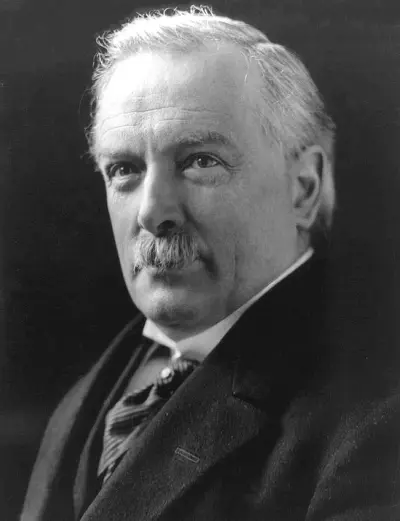
David Lloyd George, 1st Earl Lloyd-George of Dwyfor, OM, PC was a Welsh statesman who served as Prime Minister of the United Kingdom from 1916 to 1922. He was the final Liberal to hold the post of prime minister, but his support increasingly came from the Conservatives who finally dropped him.
