Frances Stevenson Quotes
The Germans were very arrogant and insolent and … this infuriated the allied delegates…. I am rather glad that they have stirred him up, so that he may keep stern with them to the very end. If they had been submissive & cowed he might have been sorry for them.
and later wife. Stevenson is describing the German foreign minister’s behavior at Versailles and Lloyd George’s angry reaction.
Frances Stevenson, 1888-1972, Mistress of Lloyd George, Diary, May 7, 1919
Sourced by: Eigen's Political and Historical Quotations

He was exactly right. Two decades later Germany had started WWII.


1st Earl Lloyd-George of Dwyfor

Germany was the enemy but the allies were fighting with each other over the treaty negotiations. David Lloyd George was the Prime Minister of England who was negotiating for that country.


Germany had just attacked Russia with whom it had a treaty. For a while, Hitler paid little attention to Italy and just gave their “ally” orders and instructions. Italian public opinion was concerned about the same question. See {627973} .

The Germans pretended to maintain the treaty and when the French totally evacuated the Rhineland, Hitler started his preparation for WWII and a little later invaded France. Clemenceau had been snookered.
He unfortunately turned out to be right as Germany started WWII to get back the territory that they lost at the Treaty of Versailles for starting WWI.

There were critics of the Treaty of Versailles in Britain as well as the United States.


The Romanovs were the family of the Russian Czars while the Hapsburgs were the family names of the Emperors of Austria. The Austrian Army Chief of Staff hated the Russians and was constantly urging war against Czarist Russia. The archduke, the heir to the Austrian throne, was constantly arguing against attacking Russia. When Franz Ferdinand was assassinated, it triggered WWI. He was no longer able to have a voice against war, and Austria and Russia were soon at war. At the end of WWI, the Austrian Empire—an ally of Germany was broken up and the Russian Revolution ended the Romanov dynasty. The Archduke was absolutely right.

This quotation is important for two reasons. First, it shows that there was a very hostile environment in Europe well before the assassination of the Archduke of Austria that “triggered” WWI. Second, that the Germans were racist before Hitler ever came on the scene. The Emperor demagogued the issue and took it to new extremes, but the evil was there. To the Germans, the Slavs and Russians were a lesser form of humanity than the Germans. The Austrians were threatening to attack Serbia and Russia. The Austro-Hungarian Empire, ruled many ethnic Slavs, Russians and Muslims—the lower forms of humanity—and long before Hitler, Wilhelm and other leading Germans thought that the Germanic Peoples should rule that part of the world as the lesser “races” were not fit to rule.

German ally, the Austro-Hungarian Empire had declared war on Serbia. See {642085}. The Russian Czar was under great pressure because a large Roman Catholic Empire was warring against a small Orthodox co-religionist of Russia and Russians of all classes wanted Russia to defend Serbia. The Czar was making a good faith effort to stave off the war. What he did not realize was that Germany had actually planned for war against Russia and France and was using the alliance with Austria as an excuse.

The Times regretted that the Germans did not speak to the Austrians more vigorously when they were threatening to attack Serbia who harbored anti-Austro-Hungarian terrorists (see {642085}). What the Times editors did not realize was that the Germans had already made their war plans (see {642092}) and the Serbian issue was just the justification they needed to implement them. So there was no real reason for the Germans to discourage the Austro-Hungarian Empire from its mission to punish Serbia.

1st Viscount Grey of Fallodon. The pace of change in the world has been accelerating ever since the enlightenment. Even at the beginning of the 20th century to was making politics difficult and be the end of the century the pace of change was many times faster.

The “proofs” were diplomatic assurances—treaties—that England would guarantee the territorial integrity of Belgium. The British made strong diplomatic efforts to persuade Germany not to occupy Belgium. The German’s none the less send armies in under the excuse that if they did not, the French would occupy the country and have a strategic advantage over them. Diplomacy could do no more good. England had to send troops or renege on its obligations. So England was in WWI.
England is entering the war against Germany The German war plan called for attacking France through Belgium. However, Belgium was intent on remaining neutral. International law prohibited a neutral country from allowing troops of either side to enter and maneuver in its territory. ({642178}). When Germany moved into Belgium, the Belgians resisted. England had a treaty with Belgium that it would protect Belgian neutrality in the event of any war in Europe. England then sided with Belgium {642175} and committed to send troops to help Belgium oust the Germans. The Kaiser was furious and could not understand that the English would go to war when there was no economic need or advantage for them to do so. Wilhelm II did not have much respect for treaties, promises, or honor other than military honor. He had earlier convinced himself that the English would not fight for a scrap of paper, especially in a land war. {642105}


Hopkins was a social worker with no military of political experience. But the President trusted him implicitly. Most American military officers and Ambassador to England Joseph P. Kennedy, a Nazi sympathizer & father of JFK, believed that England could not stand up to Hitler. Any military aid we gave England would fall into the hands of the Germans. Everyone was shocked when Roosevelt sent Hopkins to England to make a military recommendation. To impress Hopkins with something he thought Hopkins would be interested in, Churchill led a tour of workers cottages built by the government. Hopkins surprised Churchill and his aids who would never forget this statement & then asked to see the military facilities. Hopkins distressed the American military by recommending that Britain could hold out against invasion if they received military aid. Despite the contrary military advice, FDR accepted Hopkins’ recommendations, and the rest is history. He had been right and much of the military wrong.


In the history of diplomacy and peace treaty negotiations, the various national representative would meet in secret, negotiate treaties and add secret clauses. Then the treaty was finally made public for approbal or ratification in the different countries no one would be told of the secret clauses. Each side would have a written secret copy of these clauses, but the publics of the country would never know. For example, the agreements about various WWII issues that were secret have not yet been made public in the United States or England. Wilson wanted to put an end to that diplomatic ploy and wanted all the peace treaty clauses to be public with nothing secret. He also wanted the deliberations to made in public woth press access. He had little support for the idea in most European nations.
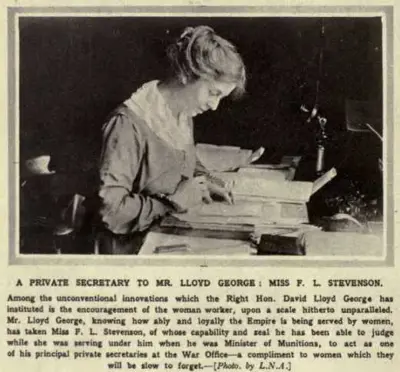
Frances Lloyd George, Countess Lloyd-George of Dwyfor, CBE was the mistress, personal secretary, confidante and second wife of British Prime Minister David Lloyd George.
