William Cosmo Gordon Lang Quotes
There can be no peace until this German spirit of Militarism is crushed.
William Cosmo Gordon Lang, 1864–1945, Scottish Anglican Prelate & Member of the British House of Lords, Archbishop of York & Archbishop of Canterbury, Statement during World War I, October 1914
Sourced by: Eigen's Political and Historical Quotations


Evelyn John St. Loo Strachey


Germany had just attacked Russia with whom it had a treaty. For a while, Hitler paid little attention to Italy and just gave their “ally” orders and instructions. Italian public opinion was concerned about the same question. See {627973} .

The Times regretted that the Germans did not speak to the Austrians more vigorously when they were threatening to attack Serbia who harbored anti-Austro-Hungarian terrorists (see {642085}). What the Times editors did not realize was that the Germans had already made their war plans (see {642092}) and the Serbian issue was just the justification they needed to implement them. So there was no real reason for the Germans to discourage the Austro-Hungarian Empire from its mission to punish Serbia.


The Hapsburgs were the ruling family of the Austrian Empire who wanted to invade Serbia in retaliation for their complicity in the assassination of the Austrian Archduke. This would likely bring Russia in the war in support of Serbia. The editor thought that there was no obligation to support Austria when they were planning a war of choice. What the editor did not know was that the German leadership very much wanted war at the time and supporting Austria was the perfect excuse to fight without them starting the conflict. However, the evidence became clear later than it was German aggression that turned the dispute into a World War.


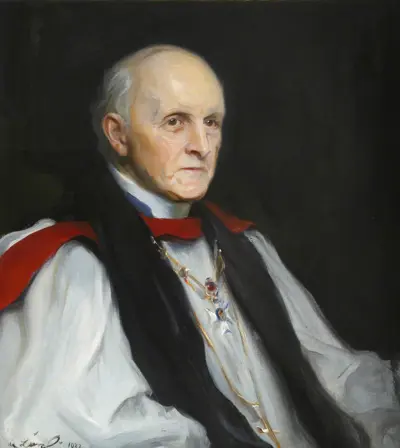
William Cosmo Gordon Lang, 1st Baron Lang of Lambeth, GCVO, PC was a Scottish Anglican prelate who served as Archbishop of York (1908–1928) and Archbishop of Canterbury (1928–1942). His elevation to Archbishop of York, within 18 years of his ordination, was the most rapid in modern Church of England history. As Archbishop of Canterbury during the abdication crisis of 1936, he took a strong moral stance, his comments in a subsequent broadcast being widely condemned as uncharitable towards the departed king.
