Samuel R. Curtis Quotes
I want no peace till the Indians suffer more.
Samuel R. Curtis, 1805-1866, U. S. Army General, Speech to his troops, Council Bluffs, 1866
Sourced by: Eigen's Political and Historical Quotations

Over the years Sherman’s advocacy of Indian extermination went beyond the Sioux to all Indians.


Self Given Title. The governor distinguished between friendly Indians from others to the consternation of Bacon and his followers.

Once blood is shed in a national quarrel, reason and right are swept aside by the rage of angry men.
1st Earl Lloyd-George of Dwyfor

First Published American Indian Author. His last public speech. He was referring to a horrible massacre of Christian Indians and the polarizing effect that such conflicts had. Whosoever publicly castigated a massacre of whites or Indians would be met by accusations of condoning the massacres of the other side and ignoring the inevitable and natural seeking of retaliation for future protection and revenge.


Sherman, one of the most gifted generals of the Civil War. He hated the cruelty of war and the Civil War in particular as he had specifically warned his Southern friends ahead of time about what war would bring. See {585882}. Sherman was one of the first American military men to look at war without any of the romantic, patriotic, noble attributes that most others did.


He was a German physician and explorer who had converted to Islam. Nonetheless, he was caught up in the Arab uprising of the Madhists, who had conquered much African territory.

It is not known whether Agamemnon ever existed other than in Greek legends. The “quotation” comes to us from Homer’s Iliad which itself was based on oral histories before and itself was oral for years before it was written. So the dialogue may be written by Homer. However, if real, was the earliest reference to genocide. The photograph is of a mask believed to be of the period but there is no certainty is was the King even though was associated with him by Heinrich Schliemann—the 19th century archeologist who found the object.


This is a very controversial Franklin quotation. In fact, Franklin never sent this letter to Strahan, but it is one of the most famous of the Franklin quotations. It was even famous in 1775. Franklin saw to it that copies of his “letter” reached most American newspaper editors, many of who reprinted it. It was not the first time that an American politician had made quotations for domestic consumption only, and it certainly was not the last. So Franklin never said this to his friend Strahan, but he did claim that he did to all who Americans who would listen. The result is that Franklin developed a reputation for really ‘telling off those Englishmen.’ This was important for him because since he had many friends and admirers in England, he was suspect to many anti-British Americans.


Published 100 years after it was written. This is the first known written statement of what became a de facto policy regarding the American Indian.
At the time there were relatively few natives left. The remainder were hunted and exterminated. Only 75 were left at the end of the “Black War” where there had been about 5,000 at the beginning. See {618042}.


Attila the Hun
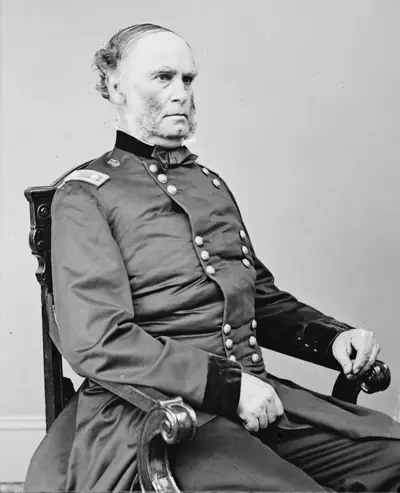
Samuel Ryan Curtis was an American military officer, and one of the first Republicans elected to Congress. He was most famous for his role as a Union Army general in the Trans-Mississippi Theater of the American Civil War, especially for his victories at the Battles of Pea Ridge in 1862 and Westport in 1864.
