American Horse Quotes
What are you going to do? Stop, men, stop and think before you act! Will you murder your children, your women, yes, destroy your nation to-day? You are brave to-day because you outnumber the white men, but what will you do to-morrow? There are railroads on all sides of you. The soldiers will pour in from every direction by thousands and surround you. You have little food or ammunition. It will be the end of your people. Stop, I say, stop now!
American Horse, 1840–1908, Oglala Lakota Chief, Speech to young warriors of the tribe who had overwhelmed two white policemen arresting an Indian and wanted to kill them, Pine Ridge Agency, 1891, Quoted in Charles A. Eastman, American Horse, Sioux Chief, 1918
Sourced by: Eigen's Political and Historical Quotations


Over the years Sherman’s advocacy of Indian extermination went beyond the Sioux to all Indians.


Clark’s men had English Colonel Hamilton under siege by making him think there were many more Americans in Clarks army than the real 180 or so. He tried to get Hamilton to surrender by threatening if they had to take the fort they would treat Hamilton and the British as murderers—Hamilton had paid hostile Indians for American scalps. At that point a party of Clark’s men arrived with 4 or 5 Indian prisoners who had been captured raiding
civilian farms. After the Indians were executed, Hamilton agreed to surrender.


A part of this quotation is very often taken out of context by just quoting the phrase “prosecution of an exterminating war” implying that Lamar was urging genocide. However, the war was urged only if the Indians did not cease their raids and massacres. Further, he specifically excludes women and children from the “extinction”. In addition he holds out the option of forced “total expulsion” if the raids continue. Brutal his threats were. And given that the whites were taking the Indians traditional lands it is easy to see where there were reasons for Indian resistance to white expansion. However, there was another reason that Lamar and most of the white settlers wanted the Indians expelled: They wanted the land.


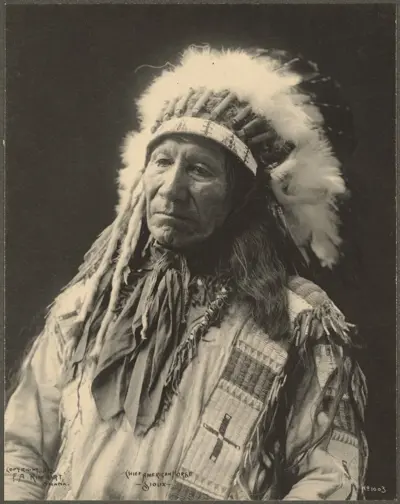
American Horse (Oglala Lakota: Wašíčuŋ Tȟašúŋke in Standard Lakota Orthography) (a/k/a "American Horse the Younger") was an Oglala Lakota chief, statesman, educator and historian. American Horse is notable in American history as a U.S. Army Indian Scout and a progressive Oglala Lakota leader who promoted friendly associations with whites and education for his people. American Horse opposed Crazy Horse during the Great Sioux War of 1876–1877 and the Ghost Dance Movement of 1890, and was a Lakota delegate to Washington. American Horse was one of the first Wild Westers with Buffalo Bill's Wild West and a supporter of the Carlisle Indian Industrial School. "His record as a councillor of his people and his policy in the new situation that confronted them was manly and consistent and he was known for his eloquence."
