Winston Churchill Quotes
Britain and France had to choose between war and dishonour. They chose dishonour. They will have war.
Winston Churchill, 1874-1965, British Prime Minister (Conservative), Speech to Prime Minister Neville Chamberlain in the House of Commons, after the Munich appeasement of Hitler, 1938
Sourced by: Eigen's Political and Historical Quotations

Neville Chamberlain is viewed in Britain as one of the worst appeasers of all time. He refused to fulfill the obligations of Great Britain when Hitler invaded parts of Europe. He appeased Hitler because he wanted to avoid war and is a historical icon of a person who would do anything to avoid war.


The Vietnam War is a good example. See {603755}.


The “fool” was Neville Chamberlain, 1869-1940, the British Prime Minister who refused to stand up to Hitler and instead negotiated a peace pact, returned home declaring that he had preserved peace. (See {585941}.) Then Hitler invaded more of Europe and WWII was begun. Ford was a Hitler admirer and pro-German (Hitler supported him for the American Presidency--{586988}—and awarded him a medal) but he thought that England had bungled the negotiations by sending someone who was very weak. In this sense his views were the same as most who were anti-Hitler.
Chamberlain’s policy was to appease Hitler and Germany to avoid war. Although he did not see Czechoslavkia as a critical British national interest and claimed he had secured peace {585941} , the reality was that he gave Germany room to start its aggression which would engulf all of Europe and much of the world. The British became the only bulwark against Hitler until the Russians stopped the Germans and America entered the war.

He was exactly right. Two decades later Germany had started WWII.


The elder Kennedy was an admirer of Hitler and Fascism and was convinced that democracy was finished in England. As the U. S. Ambassador to England, his views—see also {610124} and {610122}—destroyed his own political career in the United States, and he thereafter kept a low profile and maintained his political aspirations through his children.


Roosevelt had withdrawn his Ambassador to Berlin, publicly reprimanded Joseph P. Kennedy, his Ambassador to England who was pro Fascist and who had said complementary things about Hitler and Mussolini. FDR made anti-German statements to a degree unknown for a country not at war. Hitler publically stated that the Germans would not be pressured. Dictators who U. S. leaders have tried to isolate and pressure, have made similar statements ever since. The American intervention was certainly effective against Hitler.


The Dutch Monarch William V, Prince of Orange, was in a very precarious position and might be deposed. Officially Harris and the British were supporting him and Harris was giving him money to firm up his regime, but their great fear was that the French would support and control the Patriot Revolutionary movement, then quite active or even intervene militarily to aid the Patriots.

This quotation is surprising in that Mrs. Roosevelt was a leading liberal and one of the leading advocates for peace. This quotation might have been authored by a right wing conservative of the early 21st century.

Shortly after, he backed off the notion of having a bloodbath removing protesting students.

Theodore Roosevelt was the Presidential nominee. Johnson was a leader of some members of Congress some of whom were extreme isolationists and some of whom were Nazi sympathizers and Hitler admirers. When the Japanese attacked Pearl Harbor later that year, Germany, fulfilling its treaty with Japan, declared war on America, Johnson’s group no longer mattered. Before WWII most Republicans were opposed to Defense Spending and accused the Democrats of being war hawks. After WWII, they flip flopped and became more hawkish than the Democrats who they accused of being soft on defense for years thereafter. See {631380} for President Roosevelt’s different view.

After the signing of the Munich Pact:
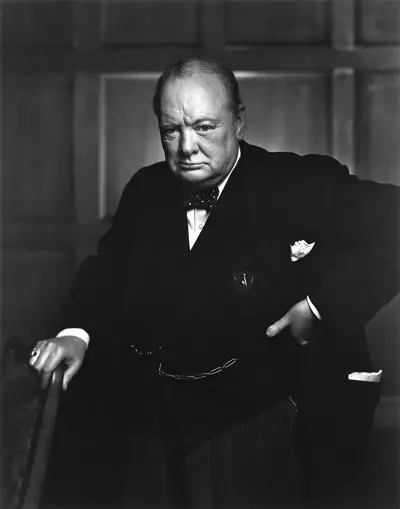
Sir Winston Leonard Spencer Churchill, KG, OM, CH, TD, DL, FRS, RA was the Prime Minister of the United Kingdom from 1940 to 1945, during the Second World War, and again from 1951 to 1955. Apart from two years between 1922 and 1924, Churchill was a Member of Parliament (MP) from 1900 to 1964 and represented a total of five constituencies. Ideologically an economic liberal and imperialist, he was for most of his career a member of the Conservative Party, as leader from 1940 to 1955. He was a member of the Liberal Party from 1904 to 1924. Churchill was also well known for his military career and as a historian, painter and writer, and among his many awards was the Nobel Prize in Literature.
