Adolf Hitler Quotes
Mr. Roosevelt. You perhaps believe that your intervention can be effective anywhere.
Roosevelt had withdrawn his Ambassador to Berlin, publicly reprimanded Joseph P. Kennedy, his Ambassador to England who was pro Fascist and who had said complementary things about Hitler and Mussolini. FDR made anti-German statements to a degree unknown for a country not at war. Hitler publically stated that the Germans would not be pressured. Dictators who U. S. leaders have tried to isolate and pressure, have made similar statements ever since. The American intervention was certainly effective against Hitler.
Adolf Hitler, 1889-1945, Fuhrer of the Third German Reich, Open speech to the German Reichstag, April 28, 1939
Sourced by: Eigen's Political and Historical Quotations


With Germany’s WWII history of military aggression, even over 60 years later, that country was very cautious about any use of military force and unilateral force was out of the question.

Chamberlain’s policy was to appease Hitler and Germany to avoid war. Although he did not see Czechoslavkia as a critical British national interest and claimed he had secured peace {585941} , the reality was that he gave Germany room to start its aggression which would engulf all of Europe and much of the world. The British became the only bulwark against Hitler until the Russians stopped the Germans and America entered the war.


Hitler ridiculed the letter after receiving it in public speech.

Ironically it was not the military situation that inhibited FDR. He did not fear the military of Germany, but he had a very isolationist Congress to contend with and a right wing America First movement of Nazi German sympathizers including hero Charles Lindbergh and Roosevelt’s own Ambassador to Great Britain, Joseph P. Kennedy. It was finally Germany who declared war on the United States after the attack on Pearl Harbor.

See {633152} for more of the reasoning for this point. “Neocon” is a shortened form of “neoconservative”. At the time the neoconservatives were advocating use of military intervention in the Middle East. Munich was the German city in which British Prime Minister notoriously tried to appease Hitler and the Nazis. This led to WWII and has become the historical icon for appeasement of a powerful tyrant and the cost of such.


Poland and most other European Governments and their people were very fearful of a strong Germany with WWII always present in their memories. However, at this time the Conservative German government had very passive policies with respect to the European Community and some German leadership and activism was thought necessary by many leaders of Europe. Germany was one of the strongest economies in Europe and without the WWII legacy of aggression would normally be expected to be more of a European leader.


When there is a serious problem with another country and it appears that military force may have to be used, he and most sophisticated policy makers argue that we should always try diplomacy first. If that does not work, then the military option is still open. If it does work, war or other military action is always available as an option. When politicians do not want to try diplomacy, it is usually that they have an ulterior motive for war and/or military force. Some urge caution with this principle in all cases as sometimes it gives the enemy time to regroup and rearm and he gets stronger by stringing out the negotiations with no intention of a diplomatic solution. In some other cases, as Iran in the second decade of the 21st century when they were suspected of developing a nuclear weapon. The Israeli right wing and some American conservatives wanted no delay in use of military force as that might allow the Iranians to complete an operational message. President Obama and most Americans favored strong economic sanctions with diplomacy first.


The report was from Heinrich von Tschirschky, the German ambassador to Austria-Hungary. He recommended that Germany persuade Austria-Hungary to not attack Serbia, not realizing the German leaders had already planned a war with Russia and saw the issues between the Austro-Hungarian Empire and Serbia was a good excuse to implement their war plans (see {642092}).


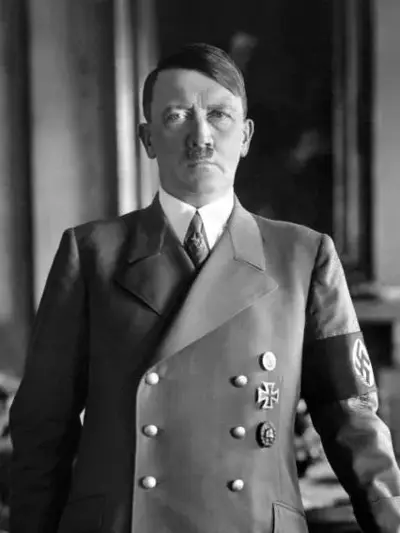
Adolf Hitler was an Austrian-born German politician who was the dictator of Germany from 1933 to 1945. He rose to power as the leader of the Nazi Party, becoming Chancellor in 1933 and then assuming the title of Führer und Reichskanzler in 1934. During his dictatorship from 1933 to 1945, he initiated World War II in Europe by invading Poland on 1 September 1939. He was closely involved in military operations throughout the war and was central to the perpetration of the Holocaust, the genocide of about 6 million Jews and millions of other victims.
