NICHOLAS II
He was forgiving them after his troops had killed some protesters the previous “Bloody Sunday” just for protesting their working conditions. See {613674} for how callous he was regarding demonstrators.
German ally, the Austro-Hungarian Empire had declared war on Serbia. See {642085}. The Russian Czar was under great pressure because a large Roman Catholic Empire was warring against a small Orthodox co-religionist of Russia and Russians of all classes wanted Russia to defend Serbia. The Czar was making a good faith effort to stave off the war. What he did not realize was that Germany had actually planned for war against Russia and France and was using the alliance with Austria as an excuse.
The general had reported to the Czar that he had peacefully dissipated a protesting mob without firing a shot. The Czar felt that the absence of shooting and killing protesters would simply encourage more protests. See {613675}.
A few months later, that is exactly what Germany did. She was hoping that England would not enter the war despite her treaty obligations, but she was willing to risk the possibility. The Czar had a strong espionage and intelligence service active in Germany, but, like so many other intelligence failures, the intelligence operatives and analysts had military and economic facts but had little understanding of the German culture which propelled Germany to what to most other cultures was “irrational policy making.” People and nations often engage in irrational activities, even against their own self-interest.
Your ideas of democracy are The Zemstvos had come to plead for reforms from the young Czar who most Russians hoped would be more modern than his all-powerful and dictatorial father. In a sense, it was this quotation that drove many moderate Russians to the radical side, and the quotation was used as a recruiting toll by both the Communist and non-Communist anti-Czarist Russians.
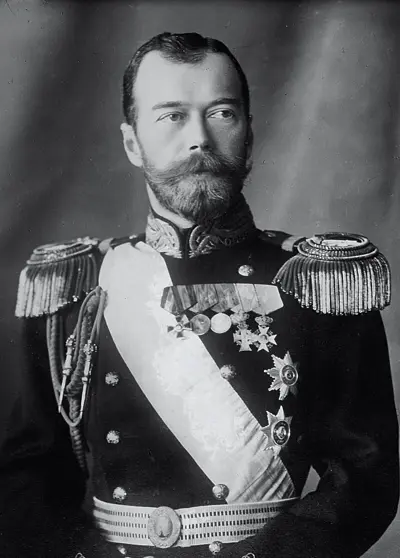
Nicholas II or Nikolai II Alexandrovich Romanov, known in the Russian Orthodox Church as Saint Nicholas the Passion-Bearer, was the last Emperor of All Russia, ruling from 1 November 1894 until his abdication on 15 March 1917. During his reign, Russia embarked on a series of reforms including the introduction of civil liberties, literacy programs, state representation, and initiatives to modernize the empire's infrastructure. Ultimately, this progress was undermined by Nicholas's commitment to autocratic rule, as well as defeats sustained by the Russian military in the Russo-Japanese war and World War I. By March 1917, public support for Nicholas had collapsed and he was forced to abdicate the throne, thereby ending the Romanov dynasty's 300-year rule of Russia.
