Nicholas II Quotes
unrealizable dreams…. I shall uphold the principle of autocracy as firmly and unflinchingly as did my ever-lamented father.
Your ideas of democracy are The Zemstvos had come to plead for reforms from the young Czar who most Russians hoped would be more modern than his all-powerful and dictatorial father. In a sense, it was this quotation that drove many moderate Russians to the radical side, and the quotation was used as a recruiting toll by both the Communist and non-Communist anti-Czarist Russians.
Nicholas II, 1868-1918, Last Czar of Russia, Statement to the Zemstvos, January 29, 1895
Sourced by: Eigen's Political and Historical Quotations

The two were cousins. Wilhelm was a very dominant personality and his cousin quite weak. This quotation shows the tyrannical view of the German Kaiser. The letters were secret but after the execution of the Czar, the Russians released the letters to show the dominant and warlike history of Germany under the Kaiser who was furious that the Russians had made such personal and secret letters public. The speech to which the Kaiser referred was one in which the Czar rejected all efforts to reform and limit his power—only driving more Russians to the revolutionary side. See the Czar’s quotation: {614054}


While President Nixon and Henry Kissinger were putting all their eggs in the Shah’s basket, Simon was one of the government who had a different perception of our key ally. See {620093} for a CIA corroborating view.

The British saw the American colonies and the East Coast Canadian provinces all as their North American possessions. With the growing dissatisfaction of the New England and other Colonies, the British wanted to secure Quebec as a safe base where there were few rebels. Fox, of the opposition, criticized the heavy-handed control of Quebec wanting to give the rights of Englishmen under the English Constitution to all citizens of the North American colonies. Had Britain done so, there may never have been an American Revolution.


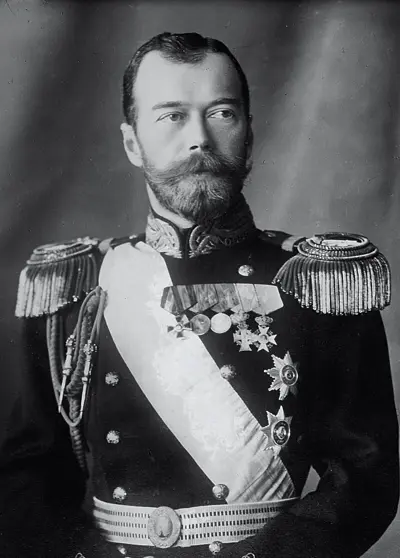
- Born: May 18, 1868
- Died: July 17, 1918
- Nationality: Russian
- Profession: Royalty
Nicholas II or Nikolai II Alexandrovich Romanov, known in the Russian Orthodox Church as Saint Nicholas the Passion-Bearer, was the last Emperor of All Russia, ruling from 1 November 1894 until his abdication on 15 March 1917. During his reign, Russia embarked on a series of reforms including the introduction of civil liberties, literacy programs, state representation, and initiatives to modernize the empire's infrastructure. Ultimately, this progress was undermined by Nicholas's commitment to autocratic rule, as well as defeats sustained by the Russian military in the Russo-Japanese war and World War I. By March 1917, public support for Nicholas had collapsed and he was forced to abdicate the throne, thereby ending the Romanov dynasty's 300-year rule of Russia.
