Nicholas II Quotes
I believe in the honest feeling of the working people and in their unshakable loyalty to me. Therefore I forgive them.
He was forgiving them after his troops had killed some protesters the previous “Bloody Sunday” just for protesting their working conditions. See {613674} for how callous he was regarding demonstrators.
Nicholas II, 1868-1918, Last Czar of Russia, Statement to a delegation of workers who had demonstrated outside the palace, February 1, 1905
Sourced by: Eigen's Political and Historical Quotations

The general had reported to the Czar that he had peacefully dissipated a protesting mob without firing a shot. The Czar felt that the absence of shooting and killing protesters would simply encourage more protests. See {613675}.


She is a leading American Arab who is a Syrian expatriate.

Goebel, a state senator, had campaigned against the railroad and corporate trusts. He was the first candidate in Kentucky to openly campaign for the Black vote and he, even though a Democrat, got it. The railroads and trusts campaigned hard for the incumbent. A very close election produced a crisis when the incumbent Republican Governor refused to give up the Statehouse and armed men converged on the capital. Somehow Goebel was shot and mortally wounded.

He was arguing that the government should be able to prohibit public demonstrations on the grounds that the protesters are “irresponsible power.” This position has been taken sometimes by the American right, and is common in all totalitarian states.

at the fall of the Soviet Union


The Muslim Brotherhood Government had just been deposed by a popular coup d’etat carried out by the Egyptian military. The Brotherhood flooded into the streets to protest the coup and some of them attacked police with weapons. The military overreacted and in an effort to clear the demonstrators from the streets killed hundreds of them. This brought out signs like this.

This quotation provides an insight into Stalin’s bizarre and ruthless character.

Armenia has no tradition for freedom of speech and assembly, and little respect for Human Rights. This quotation illustrates what many of our American lawmakers were concerned with when they prohibited the military from being used domestically against civilians. When a national Guard Unit is called up, the Pentagon no longer controls the soldier but the State Governor and his State National Guard Commander have the command and control.

Bashir Assad responded to some peaceful protests triggered by the Arab Spring throughout the Middle East by allowing his security forces to shoot unarmed demonstrating civilians and shelling with artillery to and apartment buildings of neighborhoods where there were large numbers of demonstrators. So many thousands of civilians were liked that the protestors, who initially only wanted more freedom, also demanded Assad’s resignation and his trial for war crimes by the World Court. Baker did not think that Assad could hold power very much longer.


Louis Napoleon had seized control of France and had very little popular support amongst the aristocracy and middle class. However, the Socialists leading the uprisings frightened them more than Louis Napoleon as the Socialists had the support of the peasants who resented the abuses of the aristocracy and many of the middle class. This was true class warfare and not at all what was possible in the United States when American conservatives would claim “class warfare” when there was a move for more progressive taxation. In Europe, class warfare really meant death and destruction, so for many who knew the history, the claim of “class warfare” was frightening and a large part of the “Red Scare” in the United States.
The law enforcement officers were the ones who broke the law when they beat and brutalized the peaceful civil rights marchers. The “white niggers” refer to the white marchers including clergy.

He had been kidnapped by the coup plotters and transported to Costa Rica. When they took over, he was not allowed back in the country despite objections to the coup by the United States and most other countries of the region. He managed to sneak back into Honduras and led a non-violent protest movement. He was finally restored to the presidency.

Several years before the Battle of Bunker Hill, revolutionary activity had already broken out in the American colonies—See {634132} for an example. This law gave the British authorities much more “clout” in dealing with the “seditious” American activities. It protected English law enforcement officials from being tried in local Colonial courts for murder or assault in putting down insurrections. George Washington and other Patriots were outraged over this law. See {634131}.

His home was right in the midst of the major riot area. The government had just instituted the draft to provide soldiers for the Civil War. The rich could avoid the draft by paying a modest fee. The Irish of New York were at just slightly above the Negro in the New York Socioeconomic scale and the two groups competed for the low skilled jobs. Many Irish felt that they were being forced to fight to free the Southern Negroes who when free would come to New York and compete for their jobs. They rioted and killed over 100 Blacks.

Two protesters were killed. The demonstration so affected the government that they pressured the Belfast local authorities to announce substantial increases in relief. The economy and the employment picture got no better that year.


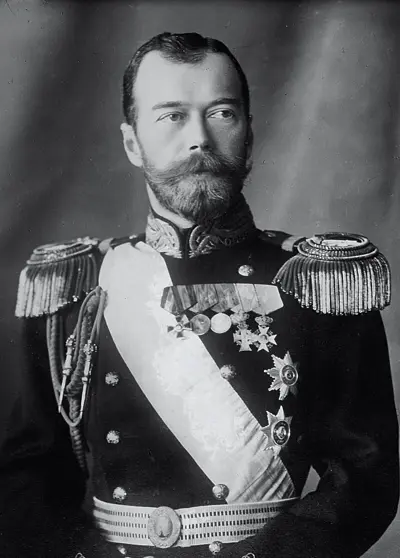
- Born: May 18, 1868
- Died: July 17, 1918
- Nationality: Russian
- Profession: Royalty
Nicholas II or Nikolai II Alexandrovich Romanov, known in the Russian Orthodox Church as Saint Nicholas the Passion-Bearer, was the last Emperor of All Russia, ruling from 1 November 1894 until his abdication on 15 March 1917. During his reign, Russia embarked on a series of reforms including the introduction of civil liberties, literacy programs, state representation, and initiatives to modernize the empire's infrastructure. Ultimately, this progress was undermined by Nicholas's commitment to autocratic rule, as well as defeats sustained by the Russian military in the Russo-Japanese war and World War I. By March 1917, public support for Nicholas had collapsed and he was forced to abdicate the throne, thereby ending the Romanov dynasty's 300-year rule of Russia.
