Belfast Telegraph Quotes
They formed up in marching order, whilst at their lead rushed a man … shouting wildly, ‘Fall in and follow me’ …. As the crowd continued to advance an order was given: ‘Draw-Ready-Charge!’ Men in the crowd went down like ninepins, and the rest fled helter skelter. Constables wearing bandoliers filled with bullets and with rifles at the ready were jumping out of caged cars…. Batons were useless and the police were compelled to fire.
Two protesters were killed. The demonstration so affected the government that they pressured the Belfast local authorities to announce substantial increases in relief. The economy and the employment picture got no better that year.
Belfast Telegraph, Northern Ireland Newspaper, Description of the police attack on a joint mixed crowd of Catholic and Protestant unemployed protesters, Belfast, October 11, 1932
Sourced by: Eigen's Political and Historical Quotations

The Police Commissioner had earlier given the green light to the police to use their clubs brutally and indiscriminately {626665} and afterwards made a statement that has been quoted ever since as he justified violating the Constitution because of their political views—see {626664}.


He was then the Home Secretary and his guidance and restraint was to avoid overreaction. The magistrates however did not act with great restraint over a series of demonstrations which culminated in 11 deaths in The Peterloo Massacre,


The demonstration was on August 8, 1643. There are several important aspects to this quotation. First, it shows that a peace movement is not only a creature of modern times. Second, that women were actively involved in political protests and demonstrations in 17th century England. Last, that the police of the time behaved as brutally as many police forces do in later centuries in putting down and surpressing demonstrations.


The State Police then attacked the demonstrators with night sticks, bull whips and tear gas. The demonstrators were trying to cross the bridge to Montgomery. There was no legal Constitutional way that the marchers could be stopped, but the Alabama State Police then constantly violated the law.

A Molotov cocktail is a glass bottle filled with gasoline and a cloth wick stuffed in the mouth of the bottle. Lighting the wick on fire and throwing the bottle at a target is a deadly weapon. Daley’s instruction if followed would have itself been a felony under Illinois law. Deadly force may only be used to preserve the life or safety of the public. If someone was making and holding Molotov cocktails in the middle of an open field and there were no people around, there would be no imminent danger and the police have many other ways of disarming and arresting the potential rioter or arsonist.
The law enforcement officers were the ones who broke the law when they beat and brutalized the peaceful civil rights marchers. The “white niggers” refer to the white marchers including clergy.


At the time, Wallace and many other Southern politicians were leading efforts to undermine the new Civil Rights Laws ending legal segregation. Most Southern police forces had been major vehicles for enforcing segregation and brutally suppressing any protests or demonstrations against segregation. Law enforcement officers had been active in lynchings and murders.
After the report was produced someone had handwritten “Draft” on it. The technique of using government agents to spread disinformation to Americans has always been very controversial. The NYPD claims that despite this report, it is the policy of the department not to allow officers to disseminate disinformation. See {589484}. He did not say that civilian agents or paid informants did not do it for the department.

This general perception led the Founding Fathers to place profound restrictions on the allowable role of the military in national law enforcement—a condition that exists to this day.

Defending his administration and the Chicago police against the charge that they used excessive force and caused a police riot during the Democratic National Convention of 1968:


The general had reported to the Czar that he had peacefully dissipated a protesting mob without firing a shot. The Czar felt that the absence of shooting and killing protesters would simply encourage more protests. See {613675}.

This proclamation was obviously unconstitutional, but at the time no one challenged it in the courts. It is yet another example, where in an emergency, executive officers of government tend to over-reach and expand their power and authority using the necessity of the emergency as the justification. This case was particularly ironic in that the mayor, so concerned with law and order that he would summarily kill people suspected of looting, was indicted and convicted for corruption the following year. His jail time was limited by a successful court appeal, and he then lost as a mayoralty candidate, but did finally get elected to the San Francisco City Council. Of course, had he been shot when first suspected of his crime—as he proscribed for others--he would never have had the opportunity to appeal and be acquitted.

Several years before the Battle of Bunker Hill, revolutionary activity had already broken out in the American colonies—See {634132} for an example. This law gave the British authorities much more “clout” in dealing with the “seditious” American activities. It protected English law enforcement officials from being tried in local Colonial courts for murder or assault in putting down insurrections. George Washington and other Patriots were outraged over this law. See {634131}.

J. Edgar Hoover, the racist FBI Director, and the Chief of Police of the all white Washington DC Police Force, had made phone calls and sent memos to as many important people they could reach, warning that there was bound to be violence if 100,00 militant Blacks tried to march on Washington. There were twice that number planned for by Bayard Rustin, the man in charge of the March planning, but 250,000 showed up. There were very few incidents and no injuries and deaths as a result of some brilliant planning by Rustin and the cooperation of Attorney General Robert F. Kennedy—the President’s brother—with Rustin. However, the fear spread by Hoover and others caused the major league baseball games to be cancelled, liquor stores to be closed, stores and offices throughout the city were intimidated and closed. But it was one of the best organized and peaceful social/political demonstrations in history.
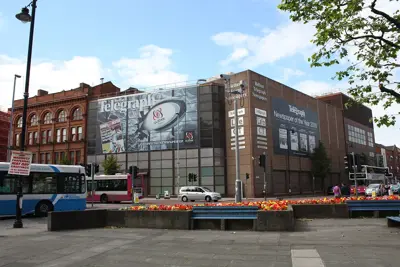
The Belfast Telegraph is a daily newspaper published in Belfast, Northern Ireland, by Independent News & Media. Its editor is Eoin Brannigan. Reflecting its unionist tradition, the paper has historically been "favoured by the Protestant population", while also being read within Catholic nationalist communities in Northern Ireland.
