Ramsey Clark Quotes
Who will protect the public when the police violate the law?
Ramsey Clark, U.S. Attorney General (Democrat), Remark after the Democratic National Convention, Chicago, August, 1968
Sourced by: Eigen's Political and Historical Quotations


By allowing illegally obtained evidence to be used in court.


In earlier years it was common practice to use undercover agents to hand out disinformation pamphlets and false rumors to confuse and diffuse crowds gathering for demonstrations. The policy was abandoned. In 2006 a September 11 report surfaced {589485} where the practice had been recommended to be resurrected. The official spokesman denied that it had, but worded the denial in a way that led many to believe that the practice had been resumed. Note that he did not say that non-police officers did not do this for the police department. That left the door open for non police officer agents of the department to spread disinformation at the behest of the police department. It employed thousands of civilian, non officer personnel, and always had many paid informants and agents.


J. Edgar Hoover, the racist FBI Director, and the Chief of Police of the all white Washington DC Police Force, had made phone calls and sent memos to as many important people they could reach, warning that there was bound to be violence if 100,00 militant Blacks tried to march on Washington. There were twice that number planned for by Bayard Rustin, the man in charge of the March planning, but 250,000 showed up. There were very few incidents and no injuries and deaths as a result of some brilliant planning by Rustin and the cooperation of Attorney General Robert F. Kennedy—the President’s brother—with Rustin. However, the fear spread by Hoover and others caused the major league baseball games to be cancelled, liquor stores to be closed, stores and offices throughout the city were intimidated and closed. But it was one of the best organized and peaceful social/political demonstrations in history.

to the Civil Rights demonstrators Hoover, an inveterate racist himself would not allow FBI agents to protect Civil Rights demonstrators (see {637634}) until he was ordered to by the Attorney General.

Two protesters were killed. The demonstration so affected the government that they pressured the Belfast local authorities to announce substantial increases in relief. The economy and the employment picture got no better that year.

Earlier, a virtually all white police force in nearby 67% Black Ferguson, had shot an unarmed black young man who was 20 feet away with his hands up, 7 times killing him and then leaving the body uncovered on the street for over 4 hours. Many people of all races began to peacefully demonstrate in Ferguson and were met with military assault weapons pointed at them and military armored vehicles, with the police illegally (as later determined by the courts) were interfering with the right to protest. The demonstrations turned to riots and there was looting and arson of business establishments. The demonstrations started to spread to nearby St. Louis and other cities as the news spread. While the Ferguson officials had behaved so badly and stupidly, the St. Louis mayor exhibited democratic leadership that was an example for others. Slay was then a 4 term mayor, being reelected more than any other mayor in St. Louis history, and was one of the outstanding politicians in America.

See {642506} for the attack on the Mayor, the illogic of which, Adams was demonstrating. As a decorated police officer, himself, Adams, was a particularly credible critic of the police union leader’s lack of logic. This was a very important quotation at the time as throughout the country almost all advocates of any kind of police reform were accused of encouraging attacks against police.

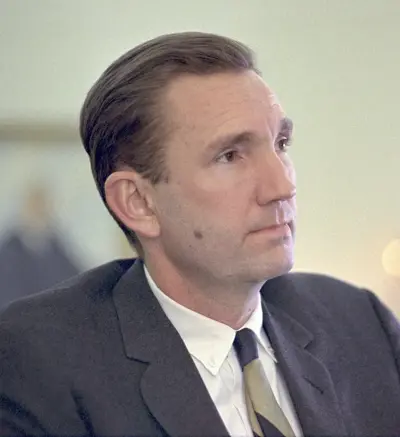
William Ramsey Clark was an American lawyer, activist and federal government official. A progressive, New Frontier liberal, he occupied senior positions in the United States Department of Justice under Presidents John F. Kennedy and Lyndon B. Johnson, notably serving as United States Attorney General from 1967 to 1969; previously he was Deputy Attorney General from 1965 to 1967 and Assistant Attorney General from 1961 to 1965.
