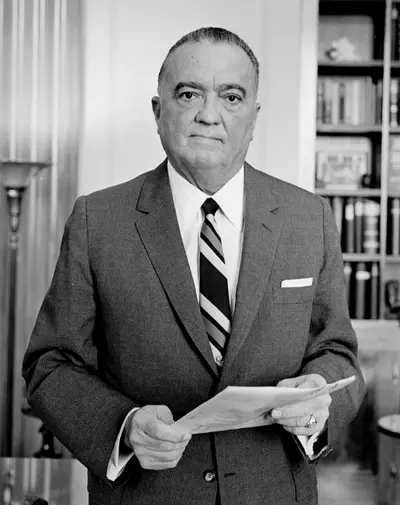
J. Edgar Hoover Quotes
… the Mississippi Highway Patrol—some of those are Klansmen, a number of the chiefs of police and the sheriffs are, and therefore you can’t count on the local people to really extend any protection .
to the Civil Rights demonstrators Hoover, an inveterate racist himself would not allow FBI agents to protect Civil Rights demonstrators (see {637634}) until he was ordered to by the Attorney General.
J. Edgar Hoover, 1895-1972, Director, Federal Bureau of Investigation, 1964, Quoted in Nick Kotz, Judgment Days, 2005
Sourced by: Eigen's Political and Historical Quotations
The leaders and their members were organizing Civil Rights protests and demonstrations in keys Southern communities. The Southern segregationists commonly referred to the protesters with these three terms. Hoover hated the Civil Rights organizations and many of their leaders and would not allow FBI agents to assure the safety of the demonstrators when they were beaten and brutalized by the Southern law enforcement officers and KKK members—often one and the same as Hoover knew ({637608}). He used the same terms describing the demonstrators as the Southerners did reflecting his biases and sympathies.
He gave this instruction before the President or Attorney General had even received the telegram as he had King’s office and home illegally bugged and he knew about the telegram before it was even sent. His people monitored Kings discussions about the telegram.
The FBI was trying to investigate the brutal murder of three civil rights workers in Mississippi—Andrew Goodman, Michael Schwerner, & James E. Chaney. However it was very difficult to get witnesses to provide information as the suspects and later defendants at trial were also members of the Klan—one of them was the Imperial Wizard of the Mississippi KKK. Other criminals were the Sheriff and his deputy.
Instead of standing and saluting as professional athletes have done for decades before games, he kneeled and refused to stand. This caused great public criticism but also some initial support. He was potentially risking his multimillion dollar salary as this technically violated his contract to avoid anything embarrassing to the team. He also donated $1 million to programs in the area that were working to enhance Black/white understanding. Even those who disagreed with his choice of protest defended his right to do so, and after the initial furor, public opinion, while not in agreement about his method, tended to support him for having the courage of his convictions and using his celebrity for a worthy cause. After sensing the public opinion, his team matches his $1 donation. Professional athletes both in the NFL and in other sports then began to do the same as a form of protest for the large, disproportionate, number of black men who were killed, mostly when unarmed, by police. The reference to the “paid leave” was the practice followed by most police departments—usually required by collective bargaining agreements with police unions—of placing police officers accused of committing violations of laws or regulations on paid administrative leave while all the investigations, hearings, and other processes . While this practice protected the rights of those police officers who were not guilty, it ended up paying brutal murders for a some time entire their case was decided or acted upon be the district attorney.
Martin Luther King and his SCLC were demonstrating in St. Augustine, Florida against the segregation in that community. The local law enforcement officers had conspired with the local KKK groups to allow the group to beat the demonstrators and then arrest the demonstrators for disturbing the peace and demonstrating in the face of a local injunction against the demonstrations. Then the local authorities placed huge bail on the arrestees that they could not easily meet. While they were in custody, they were tortured in various ways. Judge Simpson, vacated the injunction and ordered that the demonstrators not be arrested, and if they were for any other crime reasonable bail be required. He also recommended prosecution of the wrong-doers. Remarkably, FBI Director J. Edgar Hoover ordered his agents not to protect the civil rights demonstrators on the grounds that the FBI should not provide protective services. Hoover had a personal hatred of King who he claimed was a Communist, a sex pervert, and a law breaker. The President then threatened the Florida Governor to send Federal Marshalls into St. Augustine if the state could not maintain law and order. The Governor and the Georgia Senators pleaded to stop the demonstrations which were being intensified because King and the Civil Rights Demonstrators were gaining huge sympathy with the general public as a result of the journalists’ reports and Judge Simpson’s findings. The Civil Rights Bill of 1964 was being filibustered by the Southern senators at that time and this was a tactical victory, but some of the civil rights demonstrators were paying a fearful physical price. Judge Simpson died 4 year later, hated by the KKK and other segregationists in Florida. However in time, even the local Floridians came to appreciate the Judge’s role. The graphic shows the Federal Courthouse named in Judge Simpson’s honor.
Given that the Black population is less than 15 percent of the total, the odds against this occurring by chance is less than 100 million to one. The problem was then very hard to solve in that in most cases the cause was not anti-Black hostility. Rather it was that most police—including some Black police officers—were more fearful for Black males relative to white males and perceived themselves or the public in mortal danger much more often with Blacks than with whites in similar situations. Much of this was a historical societal bias and fear of Black males and much was the result of the disproportionate media depiction of violent Black males.
- Born: January 1, 1895
- Died: May 2, 1972
- Nationality: American
- Profession: Public Servant
John Edgar Hoover was an American law enforcement administrator who served as the first Director of the Federal Bureau of Investigation (FBI) of the United States. He was appointed director of the Bureau of Investigation – the FBI's predecessor – in 1924 and was instrumental in founding the FBI in 1935, where he remained director for another 37 years until his death in 1972 at the age of 77. Hoover has been credited with building the FBI into a larger crime-fighting agency than it was at its inception and with instituting a number of modernizations to police technology, such as a centralized fingerprint file and forensic laboratories. Hoover is also credited with establishing and expanding a national blacklist, referred to as the FBI Index or Index List, renamed in 2001 as the Terrorist Screening Database which the FBI still compiles and manages.