J. Edgar Hoover Quotes
Rabble Rousers -- Communists -- Outsiders
The leaders and their members were organizing Civil Rights protests and demonstrations in keys Southern communities. The Southern segregationists commonly referred to the protesters with these three terms. Hoover hated the Civil Rights organizations and many of their leaders and would not allow FBI agents to assure the safety of the demonstrators when they were beaten and brutalized by the Southern law enforcement officers and KKK members—often one and the same as Hoover knew ({637608}). He used the same terms describing the demonstrators as the Southerners did reflecting his biases and sympathies.
J. Edgar Hoover, 1895-1972, Director, Federal Bureau of Investigation, Descriptions of the leaders of CORE, SNCC, SCLC, and other Civil Rights organizations, 1964
Sourced by: Eigen's Political and Historical Quotations

to the Civil Rights demonstrators Hoover, an inveterate racist himself would not allow FBI agents to protect Civil Rights demonstrators (see {637634}) until he was ordered to by the Attorney General.


"Extremists" as Flexner used the term were intellectual and philosophical extremists--at that time intellectual communists, fascists, atheists, libertarians, anarchists. In the 21st century, "extremists" tended to connote violence and terrorism. There were violent revolutionary communists, fascists and anarchists, but there were very few. Must were intellectual and philosophical advocates of the theories.

The first Russian Revolutionary Newspaper for Workers. Volodarsky shot to the top of the early revolutionary leadership. Most of the early Russian leaders were intellectuals and theoreticians. Valodarsky had much organizing experience and could communicate well with workers having been active in the Ladies Garment Workers Union and the American Socialist Party. His practical American approach was just what was needed and he became a key member of the leadership. He was so instrumental in the Bolshevik leadership that he was targeted for assassination along with Lenin and Uritsky. Lenin was only wounded. The others died. Goldstein was only 27 years old. Russia named bridges, schools and warships after him.


First Lady Eleanor Roosevelt had more influence and visibility than any other first lady, before or since. She was First Lady for 3+ terms—longer than any other, and in addition to her official duties, she wrote a very popular daily newspaper column. As FDR was handicapped and could not travel much, she traveled all over the nation and the world. She was also very outspoken and no one ever knew whether or not she was speaking with the President’s concurrence or was on her own. She tended to be very liberal—especially in terms of the evils of racial segregation—then legal, and the problems of workers. Her broad influence was very damaging to Southern Segregationist groups and arch Conservative economic groups, who realized that her influence in the change of public opinion was much more effective at changing America than were the socialists and communists who were calling for revolution and were so unappealing that they could easily be attacked. Mrs. Roosevelt was for them more dangerous than Communism.


His book, Steal This Book, was a best seller.
This is another example where our intelligence analysis was totally wrong. It also shows that intelligence being influenced by ideology and politics has a long history in America as elsewhere.


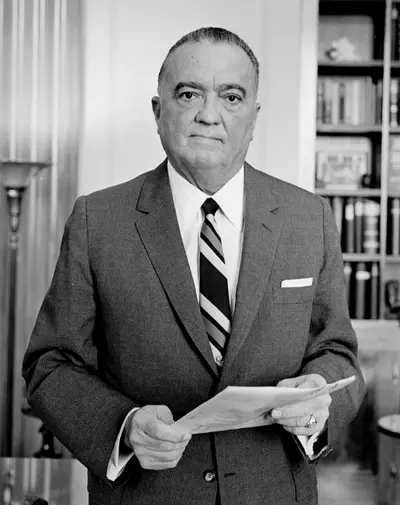
- Born: January 1, 1895
- Died: May 2, 1972
- Nationality: American
- Profession: Public Servant
John Edgar Hoover was an American law enforcement administrator who served as the first Director of the Federal Bureau of Investigation (FBI) of the United States. He was appointed director of the Bureau of Investigation – the FBI's predecessor – in 1924 and was instrumental in founding the FBI in 1935, where he remained director for another 37 years until his death in 1972 at the age of 77. Hoover has been credited with building the FBI into a larger crime-fighting agency than it was at its inception and with instituting a number of modernizations to police technology, such as a centralized fingerprint file and forensic laboratories. Hoover is also credited with establishing and expanding a national blacklist, referred to as the FBI Index or Index List, renamed in 2001 as the Terrorist Screening Database which the FBI still compiles and manages.
