J. Edgar Hoover Quotes
Neither King nor anyone else is to be furnished protection.
He gave this instruction before the President or Attorney General had even received the telegram as he had King’s office and home illegally bugged and he knew about the telegram before it was even sent. His people monitored Kings discussions about the telegram.
J. Edgar Hoover, 1895-1972, Director, Federal Bureau of Investigation, Instructions to his FBI staff after Martin Luther King had sent a telegram to the President, the Attorney General, and to Hoover asking for federal protection of himself and the other Civil Rights demonstrators who were being brutalized by local and state law enforcement officers in the South
Sourced by: Eigen's Political and Historical Quotations

to the Civil Rights demonstrators Hoover, an inveterate racist himself would not allow FBI agents to protect Civil Rights demonstrators (see {637634}) until he was ordered to by the Attorney General.


There was violence but ironically in the bombing of the 16th Street Baptist Church, it was not the civil rights leaders who were murdered but 4 little girls.


The bipartisan Presidential Commission had unanimously made 41 recommendations to prevent future terrorist attacks. While the Bush Administration and Congress implemented a few many of the more critical ones were left unaddressed. The commission on its final day issued a report card giving failing grades to both the White House and the Republican-controlled Congress.


He was not advocating this level of military presence. He was explaining that there is a trade-off between safety and civil rights and quality of life.


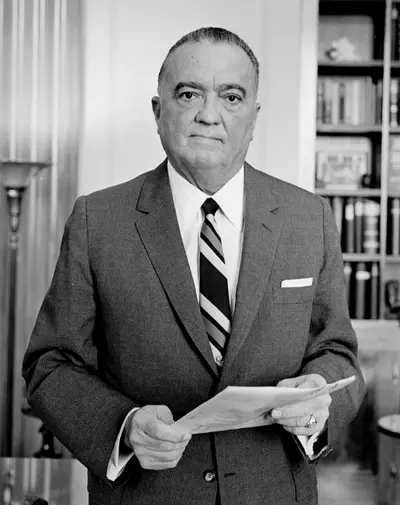
- Born: January 1, 1895
- Died: May 2, 1972
- Nationality: American
- Profession: Public Servant
John Edgar Hoover was an American law enforcement administrator who served as the first Director of the Federal Bureau of Investigation (FBI) of the United States. He was appointed director of the Bureau of Investigation – the FBI's predecessor – in 1924 and was instrumental in founding the FBI in 1935, where he remained director for another 37 years until his death in 1972 at the age of 77. Hoover has been credited with building the FBI into a larger crime-fighting agency than it was at its inception and with instituting a number of modernizations to police technology, such as a centralized fingerprint file and forensic laboratories. Hoover is also credited with establishing and expanding a national blacklist, referred to as the FBI Index or Index List, renamed in 2001 as the Terrorist Screening Database which the FBI still compiles and manages.
