Stephen Decatur Quotes
It [the treaty with Algeria] has been dictated at the mouths of our cannon..
The Barbary Pirates had an incredible extortion racket going in the Mediterranean. If nations would pay them an annual sum each year, they would not attack and seize merchant ships of that country and sell the ships and goods while holding the sailors for ransom. President Jefferson had first dispatched American warships and authorized a major land operation which were very effective. Finally, a treaty was negotiated but Decatur reminded the Navy of what brought the Algerians to the negotiating table.
Stephen Decatur, 1779-1820, Commodore, U.S. Navy, Letter to U. S. Navy Secretary Benjamin W. Crownshield, July 5, 1815
Sourced by: Eigen's Political and Historical Quotations

This was part of the negotiation of a peace treaty with the Barbary States. The Barbary Pirates had an incredible extortion racket going in the Mediterranean. If nations would pay them an annual sum each year, they would not attack and seize merchant ships of that country and sell the ships and goods while holding the sailors for ransom. Military action on land and sea by American marines and naval ships had caused much damage and intimidated the Barbary States somewhat. See {640870}


This was not the ravings of a right wing extremist. It was normative for Prussia as a whole. Right wing extremism as we think of it today was the norm of the ruling classes in Prussia and other parts of Germany. This book was a best seller in Germany. This quotation illustrates the mentality of the conservative, militarist, culture that dominated Germany at the time. The German aggression of WWI was not even considered as immoral but a God-given right.

In this case, he was referring to the situation with the Barbary Pirates who had an incredible extortion racket going in the Mediterranean. If nations would pay them an annual sum each year, they would not attack and seize merchant ships of that country and sell the ships and goods while holding the sailors for ransom. Jefferson favored and authorized war—a naval attack which for many reasons the European nations had not done (they just paid the tribute). Then a peace treaty was finally signed—the first American Treaty.

While to Madison the principle that “war is better than tribute” was “settled policy”, there were many who disagreed. See {640867} as an example.

The Barbary Pirates had an incredible extortion racket going in the Mediterranean. If nations would pay them an annual sum each year, they would not attack and seize merchant ships of that country and sell the ships and goods while holding the sailors for ransom.


Every major Western power and Japan were looking to control parts of China for their own mercantile advantage. The Emperor, her adopted son, had stated that under no circumstances would the Chinese fight, but Cixi issued this decree, in effect, overruling the Emperor—a remarkable occurrence.


This view maintains that a nation must be willing to use force and appear to others that it is willing if it is to get any benefit from soft power. Others disagree.

The violent IRA logic had always been a little tortured. At the time, the claim was that the British were not wanted in Ireland but were there only by force of arms. However, the British administration of Ireland at the time was not forceful or violent at all. Few others had the freedom and democracy of Ireland as a part of Great Britain. De Valera’s logic was that if the British in Ireland were subjected to violent, terrorist attacks, they would respond with force of arms, and thus show that they held Ireland by force. Most of the Catholics of Ireland preferred independence while most of the Protestants preferred the relationship with England.

At the time many physicians believed that “bleeding” patients would contribute to their health. So bloodletting was then a standard medical treatment.

See {633152} for more of the reasoning for this point. “Neocon” is a shortened form of “neoconservative”. At the time the neoconservatives were advocating use of military intervention in the Middle East. Munich was the German city in which British Prime Minister notoriously tried to appease Hitler and the Nazis. This led to WWII and has become the historical icon for appeasement of a powerful tyrant and the cost of such.
This was written when the United States was not a dominant military power. At the beginning of the 20th century, the U. S. had the same size military as Argentina. It was France, German, Turkey and England who had the military superiority and it was they who tended to find excuses for war. After WWII, the U. S. was dominant and was involved with a number of wars and military incursions, often with nations that had not attacked the U.S. Korns’ principle was most dramatic when the George W. Bush administration invaded Iraq on the excuse that the Iraqis were developing weapons of mass destructions and then might attack the United States. After the successful invasion, the excuse was shown to be hollow as there were no signs of sophisticated weapons development.


after Isabella’s & Ferdinand’s death. When he was Viceroy after the monarchs, he put down an attempt by some of the nobles to gain control when they asked by what authority he functioned, now that the monarchs who appointed him were dead.
Angered by the kidnapping and imprisonment of Americans and tired of paying tribute to the Barbary pirates, Jefferson sent John Paul Jones to Algiers to “negotiate” a deal.
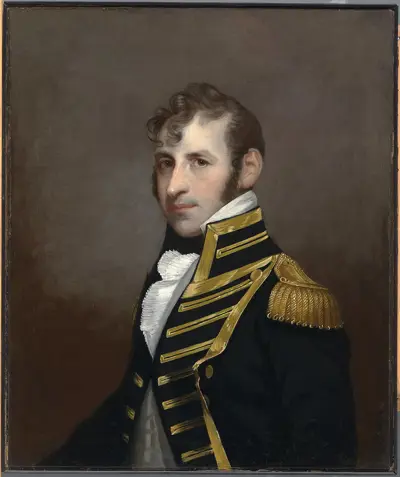
- Born: January 5, 1779
- Died: March 22, 1820
- Nationality:
- Profession:
Stephen Decatur Jr. was a United States naval officer and commodore. He was born on the eastern shore of Maryland in Worcester County, the son of a U.S. naval officer who served during the American Revolution. His father, Stephen Decatur Sr., was a commodore in the United States Navy, and brought the younger Stephen into the world of ships and sailing early on. Shortly after attending college, Decatur followed in his father's footsteps and joined the U.S. Navy at the age of nineteen as a midshipman.
