JOHN MARSHALL
(John James Marshall)


This quotation was used throughout American history. See Oliver Wendell Holmes {603715}, Daniel Webster {37299}. Maurice L. Duplessis of Canada had a contrary variant: {600341}.
Marshall was in general very sympathetic with the Indians and their rights, but even for him the notion of treating the Indians as sovereign masters of all their lands was unthinkable.
While many use the invention and development of the Steamboat as an example of breakthrough technology by private enterprise, the reality was that Fulton and Livingston could not raise the private capital to develop the vessels and start operating them until the State government stepped in and granted them a monopoly for 20 years in the waters of the entire state of New York including the Hudson River and New York Harbor. This was one of the first examples of “corporate welfare” and subsidies for development of new technology. Fulton’s company used the courts to enjoin anyone else from operating a steamboat, and Fulton could charge very high rates as he had no competition thanks to New York State. Other boat operators then went to New Jersey which passed its own allowing anyone stopped by NY courts to sue Fulton & Livingston for triple damages. The lower Hudson River and New York Harbor was on the shores of BOTH states and each had an equal claim to jurisdiction. The Supreme Court settled the dispute in one of the major legal cases in American history. See {624486}
Marshall is famous for, as Chief Justice, establishing the principle that the Judiciary can override Congress and the Executive in determining Constitutionality. However, as this quotation illustrates this principle had been discussed in open debate on the ratification of the Constitution. It was not simply a grab for power by a Chief justice; he uttered this quotation long before he ever suspected he would be a judge but actually spent much of his career in the executive and legislative branch of government.
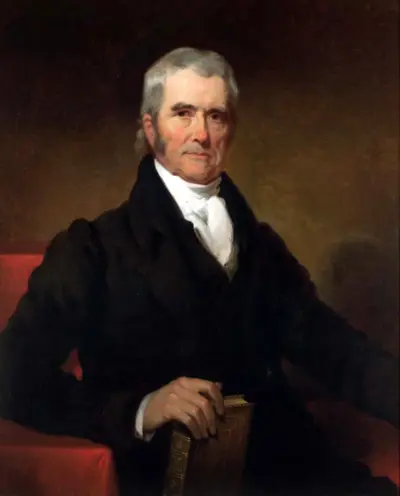
John Marshall was an American politician and lawyer who served as the fourth Chief Justice of the United States from 1801 to 1835. Marshall remains the longest-serving chief justice and fourth-longest serving justice in Supreme Court history, and he is widely regarded as one of the most influential justices to ever sit on the Supreme Court. Prior to joining the Supreme Court (and for one month simultaneous to his tenure as Chief Justice), Marshall served as the United States Secretary of State under President John Adams.
