John Marshall Quotes
A corporation is an artificial being, invisible, intangible, and existing only in contemplation of law. Being the mere creature of law, it possesses only those properties which the charter of its creation confers upon it, either expressly or as incidental to its very existence
John Marshall, 1755-1835, Chief Justice of the U. S. Supreme Court, U. S. Congressman (Federalist, VA), U. S. Secretary of War, U. S. Secretary of State, Dartmouth College v. Woodward, 1819
Sourced by: Eigen's Political and Historical Quotations

Romney was trying to explain that the Supreme Court had recently ruled that for purposes of placing limits on campaign donations, corporations were entitled to the same rights of free speech and contributing money as people. The candidate chose this statement to express that view. However, the way Romney phrased it made many people suspect that perhaps, because of his lifetime corporate activity, he really thought that there were no differences between corporations and people. This suspicion reinforced a public feeling that Romney was much more corporately oriented than he was people oriented, and that hurt Romney with many voters.

McCain held this view despite the fact that most other politicians of his party supported removal of any corporate restraints.


A constant major issue in industrial democracies are the perceptions, rights and responsibilities of corporations. For those like Romney, corporations should have all the privileges, empathy, rights and obligations of individual people. To most others a corporation is morally and practically a different entity. See {586119}.


The term “great corporations” had been in common use to indicate large corporations with no implications of quality as “great” would imply today. Search for “great corporations” to see the common usage.


This issue arose in 2014 with the Citizens United Case, when a 5-4 decision of the Supreme Court held that political contributions were a form of political speech and corporations had the right of Freedom of Speech. This time there were 4 dissenters.


TR came from a wealthy, upper class family, and because of his position favoring regulation of corporations he was called a traitor to his class by many.
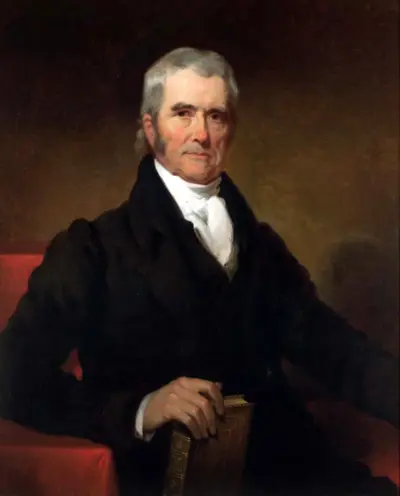
John Marshall was an American politician and lawyer who served as the fourth Chief Justice of the United States from 1801 to 1835. Marshall remains the longest-serving chief justice and fourth-longest serving justice in Supreme Court history, and he is widely regarded as one of the most influential justices to ever sit on the Supreme Court. Prior to joining the Supreme Court (and for one month simultaneous to his tenure as Chief Justice), Marshall served as the United States Secretary of State under President John Adams.
