JOHN QUINCY ADAMS

After Adams took the oath of office, he wrote to his wife Abigail about Washington's great satisfaction at leaving office:

Upon learning that his son, John Quincy Adams, had been chosen President of the United States, the former President remarked:

First ladies have often advised as to campaign tactics and strategy. In 1824 it was considered unseemly to actively campaign for the presidency. Adams did and won. Advice continued

Adams, after his presidency, served in the House of Representatives for many years. He collapsed at his desk in the House and died in the Speaker’s office.


After John Quincy Adams lost his bid for a second Presidential, he ran for the House of Representatives from his native Massachusetts and served there till his death at his desk. He is the only President to be elected to Congress after his Presidency, He was always an eloquent speaker, and he got better with age. Hence the “old man eloquent.”

In 1827 John Quincy Adams and Andrew Jackson were potential presidential rivals. Many people and newspapers were openly critical of Jackson since his wife Rachel did not have a finalized divorce when the Jacksons were married. Jackson supporters started 'retaliating' with the story that Adams and his wife had engaged in pre-marital sexual relations. Jackson stopped this.

In the 1824 presidential election Jackson won a plurality of popular and electoral votes but not a majority. The election was thrown into the House of Representatives where Speaker Henry Clay cut a deal with John Quincy Adams who had finished second. Adams became President and Clay, Secretary of State.


Hayes was a Civil Service reformer. After the presidency of John Quincy Adams, Andrew Jackson and subsequent Presidents fired large numbers of public servants—even minor poitions and replaced them with supporters. Hayes stopped that practice and initiated civil servce reform.

When the Republican leadership in 2008 stated that the Republican’s primary objective was to prevent the re-election of Barack Obama, it was not the first time that American politicians admitted that their major objective was to cripple an administration. This quotation shows a very early example. See {592642} for Adams view of Senator Randolph.
He was then serving as the U. S. Ambassador to Russia
In the original Constitution the apportionment of members of the House of Representatives was based on the white population plus After his Presidency, Adams served in the House of Representatives for many years and was thus active in politics.
After his Presidency, Adams served in the House of Representatives for many years and was thus active in politics.
In what turned out to be a tragic prediction of things to come:
Colonel Richard M. Johnson, Vice President of the United States under Martin Van Buren, 1837-1841, was:
The president had visited Baltimore in August of 1828 and found the campaigning at a feverish pace:
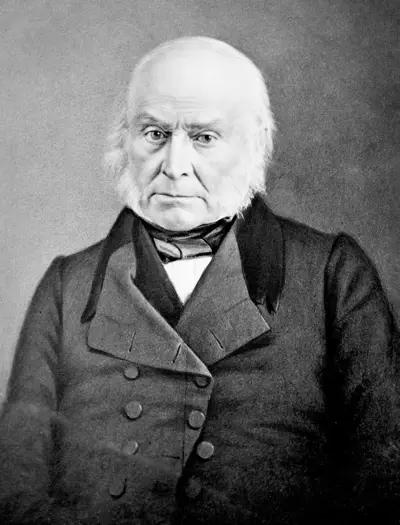
- Born: July 11, 1767
- Died: February 23, 1848
- Nationality: American
- Profession: President
John Quincy Adams was an American statesman, diplomat, lawyer, and diarist who served as the sixth president of the United States, from 1825 to 1829. He previously served as the eighth United States Secretary of State from 1817 to 1825. During his long diplomatic and political career, Adams also served as an ambassador, and as a member of the United States Senate and House of Representatives representing Massachusetts. He was the eldest son of John Adams, who served as the second U.S. president from 1797 to 1801, and First Lady Abigail Adams. Initially a Federalist like his father, he won election to the presidency as a member of the Democratic-Republican Party, and in the mid-1830s became affiliated with the Whig Party.
