John Quincy Adams Quotes
...he [Muhammad] declared undistinguishing and exterminating war, as a part of his religion, against all the rest of mankind...The precept of the Koran is, perpetual war against all who deny, that Mahomet is the prophet of God.
Adams, John Quincy. The American Annual Register for the Years 1827-8-9. Vol. 3, New York: E. and G. W. Blunt, 1830, p. 269.


This is the “logic” by which Islamic terrorists have justified murder of civilians. Just as all Muslim men are fighters for Allah, all infidels are fighters against Allah and thus should die.

Slogans taken from posters listing 10 people targeted by Muslim extremists. Most were people who had said or published material that some fundamentalist Muslims had decided were offensive to Islam. One was Charlie Hebdo, the French Publisher who Islamic terrorists murdered later. Note the Americanisms that the terrorist propagandists adopted. The Wanted Dead or Alive was taken from the posters of the American West of the 19th century. The "Yes we can" was lifted from the Barack Obama 2008 campaign slogan. The "Bullet A Day Keeps the Infidel Away" is a takeoff on the American saying "An apple a day keeps the Doctor away." One of the reasons for these Americanisms was that the founding editor was Samir Khan, self-described American traitor.


In September of 2006 Pope Benedict XVI, quoted this statement in a lecture to theological students. There was much distress and protest among Muslim leaders.

She is a leading American Arab who is a Syrian expatriate.


Professor Tibi and others have also pointed out that with this definition within Islam, there is no possible justification for a non-Muslim state to war against a Muslim state even of the non-Muslim state was attacked first. However, note that most educated Muslims, like Dr, Tibi, do not hold this preposterous position. It does however illustrate why some Muslims can be outraged when Israel fights back against the thousands of rockets fired from Gaza. To them the 7000 rocket firing was a just war to make Israel a Muslim territory, but no retaliation by non-Muslims can be just.
This quotation demonstrates that religious persecution of non Muslims was a duty, This has been a characteristic of all religious persecution regardless of religion. The quotation also shows that after 600 years, the original limited tolerance the Prophet had urged for People of the Book (Jews and Christians) was waning. Instead of non-believers being tolerated if they paid the special tax and were second class citizens, leaders were urged to convert or eliminate “infidels.”

In the early stages of Islam, Muhammad had hoped to convert the Jews and others on the Arabian Peninsula. When they refused to be converted, he warred against them usually killing the men, and taking the women and children as slaves. The result was that non-believing tribes were “cleansed” from the Arabian Peninsula. The Muslims at the time preferred children as slaves. For then they could convert the children against their will. Adults in Islam must accept Islam in order to convert. Children are regarded as having no such maturity of decision making and therefore opposition to conversion may be ignored and they may be forced. Critics of Islam and those who argue that Islam is at odds with all other religions point to this quotation. They claim that it is the only religion whose founder and fundamental scriptures demand war against others for no other reason than that they believe in a different religion. The Catholic Church during the Crusades and the Inquisition had a similar philosophy as did Christian missionaries colonizing Africa later. One difference is that most Christians today repudiate the doctrine as against the true spirit and teachings of Christ and view it as historical error, while very few modern Muslims repudiate this quotation of the Prophet.


Christians of 1 thousand years ago were barbarous and immoral compared to Christians of today, even though their Bible is the same. He argued that Islam may well also reform. In looking at Islam compared with Judaism, Christianity, Hinduism and Buddhism, it is useful to remember that these are much older religions than Islam. They have had more time to reform and develop. Compare Christians 700 years ago to Christians today. They were pretty barbaric in comparison. They burned heretics at the stake and "witches" also. But Islam is 700 years younger than Christianity and thousands of years younger than the other 3 religions mentioned. It may well need more time to develop and reform.
It is this verse that for some Muslims justifies terrorism against non-Muslims. See {584354} for a specific example. There are similar provisions in the Old Testament which a few extremely conservative Jews and Christians have used to advocate for blasphemy being a capital crime. Note that if an unbeliever repents and becomes a Muslim, he should be spared.
“Musselman” was then a term for Muslims used by Europeans. The Arabs then, as many terrorists still do, commonly captured American and European ships enslaving the crews and passengers or holding them for ransom. Jefferson and Adams explained that if this could not be stopped and resolved it might mean war. The Americans could not understand why they were attacked when American had done nothing to offend the Arab Counties. The Arab envoy explained their “duty” and “right” to attack Americans and why war was not a serious deterrent to Islamic nations. Ironically, the same explanations were given by Arab leaders in the early 21st century to illustrate why the Arab countries could not be intimidated.

See {586041} for a Koranic quotation that urges world domination by Islam. In this quotation, The Prophet was talking to his followers at a time when Islam was not even a dominant religion in Arabia. And war was the way in which tribes, groups, and religions and sects, established themselves and grew. Although there are other Koranic passages which tell the faithful that people can only legitimately come to Islam through individual commitment and willingly, this passage not only seems to contradict that but also reflects a desire to punish and disgrace “non-believing” groups. This vengeance motif is also contradictory to much else of the Koran which generally preaches love, forgiveness, and understanding. However, there are contradictions and intellectual inconsistencies within the Koran just as there are within the Old and New Testaments.
See {586039} for a quotation that goes further and seeks to punish and humiliate the non believers. This sura is often used by those wishing to illustrate the intolerance of Islam—especially of other religions. They fail to put this into the context of the Old Testament which proscribed death for heretics or the history of Christianity regarding the murder of nonbelievers. The difference is however, that a very small proportion of Jews or Christians today believe in following Biblical instructions in this respect while the proportion of Muslims who believe in the literal interpretation of scripture on these points is much larger. However there are Islamic modernists and moderates throughout the world who reject this notion of warring on all other religions and there is a struggle going on within Islam itself.
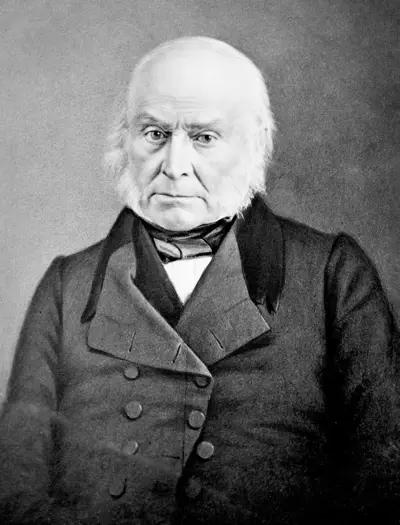
John Quincy Adams was an American statesman, diplomat, lawyer, and diarist who served as the sixth president of the United States, from 1825 to 1829. He previously served as the eighth United States Secretary of State from 1817 to 1825. During his long diplomatic and political career, Adams also served as an ambassador, and as a member of the United States Senate and House of Representatives representing Massachusetts. He was the eldest son of John Adams, who served as the second U.S. president from 1797 to 1801, and First Lady Abigail Adams. Initially a Federalist like his father, he won election to the presidency as a member of the Democratic-Republican Party, and in the mid-1830s became affiliated with the Whig Party.
