John Quincy Adams Quotes
I am not using the word slavery. I am simply reading from the petitions I have received from my constituents wishing Congress to redress their grievances.
After Adams’ term as President, he was elected to the House of Representatives where he served for the rest of his career. He was constantly calling for the emancipation of slaves (see {77463}) in the House debates. The Southern Congressmen were so offended by this that they got the majority of the House to pass a rule that made using the word “slavery” out of order. It was called the “Gag Rule”. Adams, one of the best legislators and lawyers of his day, then started reading in the House debates petitions of his constituents calling for an end to slavery. The Southerners called for the Speaker to declare him out of order for violating the gag rule. But Adams pointed out that the Constitution gave citizens the right to petition Congress with no controls on the petitions. Therefore the reading of the petitions was Constitutionally mandated and trumped the Rules of the House. He then arranged to have many petitions submitted which he dutifully read on the House floor to the extreme anger of the Southerners.
John Quincy Adams, 1767-1848, 6th President of the United States (Independent, MA), Statement to the Speaker of the House who had ruled Adams out of order for using the word “slavery”
Sourced by: Eigen's Political and Historical Quotations


The Federal Fugitive Slave Act required all in free states to assist owners of escaped slaves to return them to their owners. In 1854 a Missouri slave owner tracked his escaped slave to Wisconsin and the Federal officials incarcerated the slave pending his return. A Wisconsin mob broke the slave out of jail and helped him escape to Canada. Sherman M. Booth, Publisher & Editor of the Wisconsin Free Soil Democrat was convicted under the Fugitive Slave Act for aiding the escape. Smith’s opinion overturned the Fugitive Slave Act on the grounds that it had usurped state’s rights. The Supreme Court overturned Smith’s ruling, but Booth was pardoned. See {587926} & {587928}. The more “dread calamity” was civil war which of course came a few years later.

In 1836 the House of Representatives adopted the so-called "Gag Rule" whereby the house could not act on all further petitions regarding slavery, even though thousands of petitions were being received. Adams was one of the few who protested the Gag Rule:. Adams even submitted petitions with which he did not agree:. Every year Adams attempted to get the Gag Rule repealed. He was even threatened with censure for his efforts, but his status as an ex-president protected him. Finally, in 1844, Adams' perennial resolution carried:

Adams had submitted to the House a petition from some of his constituents calling for a dissolution of the Union on the grounds that the existence of slavery nullified a sufficient part of the Constitution and the Bill of Rights so that the union should be nullified and in effect anti slavery states such as Massachusetts would not be bound by slavery supporters blocking anti-slavery legislation. State’s rights and succession cut both ways potentially in America’s race history. The vast majority of the house members were indignant that any responsible member would introduce a petition, and there were calls for Adam’s expulsion from the House from the majority of the members. The leadership however thought this might set some bad precedents, and tried to persuade the membership to on the grounds of mercy and comity just censure him. Adams responded with this famous quotation cutting the legs from under both the leadership and the membership with the result being that no action was taken.

Later changed the name to The Emancipator. Many are surprised that a Southern State would have had such strong abolitionist sentiment so early, but East Tennessee was a hotbed of abolition. See {614117} and {614069}


Although Wedgwood was a business man and ceramic manufacturer, he was a staunch abolitionist. He made these medallions by the thousands and gave them to all who would receive them. The text became the motto of the anti-slavery society. It was one of the first examples of a logo – a symbol for a political cause being very effective.


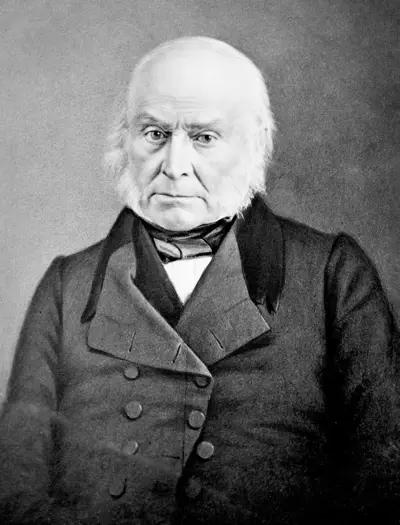
John Quincy Adams was an American statesman, diplomat, lawyer, and diarist who served as the sixth president of the United States, from 1825 to 1829. He previously served as the eighth United States Secretary of State from 1817 to 1825. During his long diplomatic and political career, Adams also served as an ambassador, and as a member of the United States Senate and House of Representatives representing Massachusetts. He was the eldest son of John Adams, who served as the second U.S. president from 1797 to 1801, and First Lady Abigail Adams. Initially a Federalist like his father, he won election to the presidency as a member of the Democratic-Republican Party, and in the mid-1830s became affiliated with the Whig Party.
