William Wells Brown Quotes
I would have the Constitution torn in shreds and scattered to the four winds of heaven. Let us destroy the Constitution and build on its ruins the temple of liberty. I have brothers in slavery. I have seen chains placed on their limbs and beheld them captive.
Brown, William Wells. Speech at the American Anti-Slavery Society Annual Meeting, New York, 9 May 1848. The Liberator, 26 May 1848.


The political machine of New York City, unlike most others in the Northeast were supporters of the Southern position on slavery. They had strong economic relations with the Southern planters and wanted to keep the federal government far away from state and local affairs.

See Joseph Addison which may have been the inspiration for this famous quote: {613374}.

The Union troops had just been routed at Bull Run. Many in the North thought that the war would be a short one with little disruption of loss of life. Here Norton, like so many others, provided a a more realistic assessment. Also note the reference to “barbarism” in the South, When the Union was formed, the Southern states were not as well developed as the North from an industrial, educational or cultural perspective. There were vestiges of aristocracy, crude law enforcement, and much more poverty (Virginia excepted) than in the North. Most Northerners thought that the South would reform—modernize and become more like the North, but instead the gulf became greater as the North itself developed and changed rapidly while the South was mired in its traditions with their aristocracy gaining more political, economic and cultural control. This attitude of Northern superiority, objectively valid though it may have been, was sorely resented by the South and this resentment has persisted into relatively modern times.


This quotation is historically important because Davis clearly states the reason for the rebellion of the South. The anti-slave states were growing at a greater rate than the slave states and despite the greater voting power that a southerner had (a result of the 3/5 count of slaves for census purposes, and the Senate), the handwriting was on the wall and the majority of the United States was against the vicious institution of slavery and would make it unprofitable, impossible and/or illegal in the coming years. Southern slavery advocates saw this as a “tyranny of the majority” and therefore took up arms. In the early 20th century, apologists for the Southern rebellion tried to promote the idea that there were reasons other than slavery, but this quotation and the resolutions of the states who withdrew from the Union make it clear that the right to maintain slavery was the only significant issue. In that sense it was a States’ Rights issue, but the South was opposed to States’ Rights when it came to States refusing to return fugitive slaves when Federal Law required such under the Dred Scott Supreme Court Decision.


As a key member of Lincoln’s cabinet, William H. Seward was most concerned with preserving The Union. However, since the Constitution was written in 1787, there had been compromises made with the pro slavery forces of the South to give them proportionally more political power and to avoid interfering with the institution of slavery. The Dred Scott Supreme Court decision forced the Northern States to actively cooperate in enforcing and maintaining slavery. Large numbers of abolitionists had reached their limit and wanted no more compromises regarding slavery. Mrs. Seward was one of those. This quotation also illustrates the influence that some women had in politics even though women could not vote. Frances Seward was very much a political partner with her husband who was favored to beat Lincoln for the Republican Presidential nomination.

The Federal Fugitive Slave Act required all in free states to assist owners of escaped slaves to return them to their owners. In 1854 a Missouri slave owner tracked his escaped slave to Wisconsin and the Federal officials incarcerated the slave pending his return. A Wisconsin mob broke the slave out of jail and helped him escape to Canada. Sherman M. Booth, Publisher & Editor of the Wisconsin Free Soil Democrat was convicted under the Fugitive Slave Act for aiding the escape. Smith’s opinion overturned the Fugitive Slave Act on the grounds that it had usurped state’s rights. The Supreme Court overturned Smith’s ruling, but Booth was pardoned. See {587926} & {587928}. The more “dread calamity” was civil war which of course came a few years later.

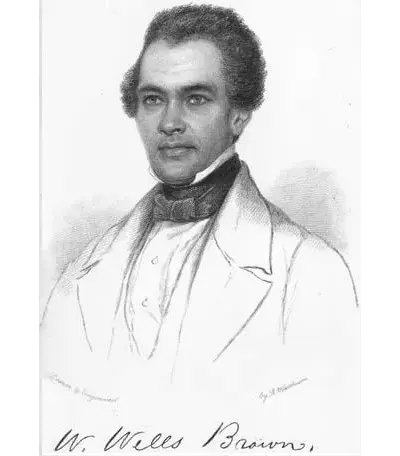
William Wells Brown was a prominent African-American abolitionist lecturer, novelist, playwright, and historian in the United States. Born into slavery in Montgomery County, Kentucky, near the town of Mount Sterling, Brown escaped to Ohio in 1834 at the age of 19. He settled in Boston, Massachusetts, where he worked for abolitionist causes and became a prolific writer. While working for abolition, Brown also supported causes including: temperance, women's suffrage, pacifism, prison reform, and an anti-tobacco movement. His novel Clotel (1853), considered the first novel written by an African American, was published in London, England, where he resided at the time; it was later published in the United States.
