John Jay Quotes
It is much to be wished that slavery may be abolished. The honor of the States, as well as justice and humanity, in my opinion, loudly call upon them to emancipate these unhappy people. To contend for our own liberty, and to deny that blessing to others, involves an inconsistency not to be excused.
Even before we had a Constitution there was major opposition to slavery. The “price” of the American Union was the acceptance of the slavery of the South. But the hypocrisy of a country based on liberty to allow and enforce slavery was not lost on the founding fathers. Ironically the abolitionists among the founding fathers were certain that they could persuade the Southern slaveholders of the error of slavery in a few years and things would be set right in the land. Even George Washington {630626}, and Thomas Jefferson and some other slaveowners at the time wished to see its abolition. Slaveholding Southern Founding Fathers in general were so wary of the abolitionists that they achieved structural, disproportionate, power in the new Constitution to ward off the abolitionists attempts to reform slavery.
John Jay, 1745-1829, President of the Continental Congress, Governor of New York (Federalist), U. S. Foreign Secretary, First Chief Justice of the U. S. Supreme Court, Letter to R. Lushington, 1786
Sourced by: Eigen's Political and Historical Quotations

Washington was from Virginia, the largest of the slave states, and he himself owned slaves. In his will he emancipated all his slaves. Most of his fellow Southern Slave owners however not only disagreed about the abolition of slavery but were adamant that slavery spread so that the abolitionists never attain a majority.

His family was one of the wealthiest in Rhode Island. He called in the entire family and he formally read the deed. The family itself had actually been active in the slave trade under John, his oldest brother, so this deed was very shocking to them. Moses became a leading abolitionist in Rhode Island and John the major defender of slavery in the state. Despite that, the brothers actually remained close.


The issue of slavery which had been suppressed in Congress for the first decades of the nation broke out when Missouri statehood was considered. By previous agreement, slavery was not even discussed in Congress but the time period elapsed. Tallmadge not only proposed that no more slaves could come into Missouri {613176} but most shocking to the Southerners was that every person born in the new state would be free at the age of 25. In a generation, there would be no more slavery in Missouri and there would be no economic compensation for slave owners at all. The House of Representatives accepted the amendment, but it failed in the Senate. At that time, Senators were not elected by voters but were appointed by the state legislators and the Southern slave states had a disproportionate share of the senate from a population point of view. But what this quotation shows clearly that a majority of the country in 1819 were opposed to slavery and were willing to end it without compensation.

The political conflict between the right of the slave to liberty and the right of the slave owner to his property made the immediate abolition of slavery very difficult after the Spanish had been overthrown in South America.

Although Wedgwood was a business man and ceramic manufacturer, he was a staunch abolitionist. He made these medallions by the thousands and gave them to all who would receive them. The text became the motto of the anti-slavery society. It was one of the first examples of a logo – a symbol for a political cause being very effective.

As an entertainer she had toured much of the world and seen American slavery and that of some other nations. She became a staunch abolitionist and like entertainers in the 20th and 21st centuries she used her celebrity to give anti-slavery lectures and perform for audiences where she donated the proceeds of the event to the abolition cause. She is a particularly interesting political figure in that she seems to be one of the first entertainers to perform for a social cause and become an activist.

Jefferson was then the United States Minister to France. While in Paris he was offered membership by M. de Warville in the Society for the Abolition of the Slave-Trade. Jefferson felt that he had to decline because his joining would have been seen as a politically polarizing act, inappropriate for an Ambassador of the American government which was divided on the issue of slavery. Some criticize the refusal and argue that this would have been the perfect act to push the abolition perspective, and question Jefferson’s sincerity about slavery as he not only refused to join the society, but never freed his own slaves though it is argued that he never made enough money to afford to emancipate them.


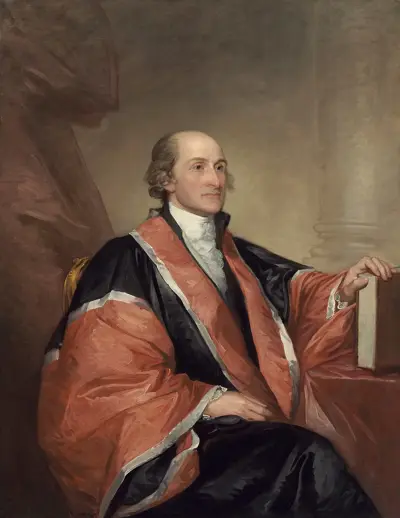
- Born: December 12, 1745
- Died: May 17, 1829
- Nationality: American
- Profession: Judge
John Jay was an American statesman, patriot, diplomat, Founding Father, abolitionist, negotiator, and signatory of the Treaty of Paris of 1783. He served as the second Governor of New York and the first Chief Justice of the United States (1789–1795). He directed U.S. foreign policy for much of the 1780s and was an important leader of the Federalist Party after the ratification of the United States Constitution in 1788.
