Gerrit Smith Quotes
We must continue to judge of slavery by what it is, and not by what you tell us it will, or may be.
Smith, Gerrit. Letter of Gerrit Smith, to Rev. James Smylie, of the State of Mississippi. R. G. Williams, 1837.

Even before we had a Constitution there was major opposition to slavery. The “price” of the American Union was the acceptance of the slavery of the South. But the hypocrisy of a country based on liberty to allow and enforce slavery was not lost on the founding fathers. Ironically the abolitionists among the founding fathers were certain that they could persuade the Southern slaveholders of the error of slavery in a few years and things would be set right in the land. Even George Washington {630626}, and Thomas Jefferson and some other slaveowners at the time wished to see its abolition. Slaveholding Southern Founding Fathers in general were so wary of the abolitionists that they achieved structural, disproportionate, power in the new Constitution to ward off the abolitionists attempts to reform slavery.

Our Founding Fathers were divided into three general views about slavery. There were abolitionists for whom slavery was abominable and should be eliminated—these were mostly in the Northern States but with a few Southerners. Then there was the opposite view held by most Southerners, that slavery was not only a natural and moral institution but it was an economic and social necessity. Last were those like Laurens, George Washington and Thomas Jefferson. Slave owners who grew up with slavery as a norm but came to see its evils and the complexity of change and reform in that area.


Brown was the richest man in Rhode Island and made much of his money in the slave trade. This quotation shows that slavery was not completely a North verses South split. Northerners like Brown for whose family Brown University was named, was as virulent supporter of slavery as the most ardent Southerner.

The highest court in New York.

This fear was great among many who were abolitionists as potentially there might be mass slaughter of all Southern whites.

The political conflict between the right of the slave to liberty and the right of the slave owner to his property made the immediate abolition of slavery very difficult after the Spanish had been overthrown in South America.


Before Wilberforce, British society had never conceived of a world without slavery. It was assumed, unpleasant and cruel that it was, slavery was a part of civilization and much of the world and economy depended upon it. However, Wilberforce changed the way slavery was conceived of --- not necessary any longer and profoundly evil.

Jefferson was an enigma with respect to slavery. Whereas he always abhorred it in his writings, and argued for an end to slavery, he maintained slaves himself and never did free them, unlike Washington, who spoke on the subject much less, but left orders in his will that all slaves were to be set free.

As a key member of Lincoln’s cabinet, William H. Seward was most concerned with preserving The Union. However, since the Constitution was written in 1787, there had been compromises made with the pro slavery forces of the South to give them proportionally more political power and to avoid interfering with the institution of slavery. The Dred Scott Supreme Court decision forced the Northern States to actively cooperate in enforcing and maintaining slavery. Large numbers of abolitionists had reached their limit and wanted no more compromises regarding slavery. Mrs. Seward was one of those. This quotation also illustrates the influence that some women had in politics even though women could not vote. Frances Seward was very much a political partner with her husband who was favored to beat Lincoln for the Republican Presidential nomination.

The Southern propaganda regarding slavery of the Day was that the Negro prefers his state of slavery to which he is naturally inclined—that the responsibility and uncertainty of freedom are not suited to the Negro temperament. As we look back upon that time, it is hard for us to believe that any sane person would for a moment believe such nonsense, but the reality is that not only did Southerners convince themselves of this, but there were many in the North who accepted the argument.


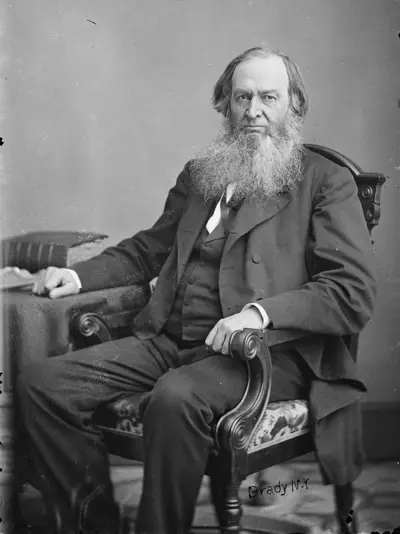
Gerrit Smith, also spelled Gerritt, was a leading American social reformer, abolitionist, politician, and philanthropist. Spouse to Ann Carroll Fitzhugh, Smith was a candidate for President of the United States in 1848, 1856, and 1860, but only served 18 months in the federal government—in Congress as a Free Soil Party Representative, in 1853–4.
