Horatio Nelson Quotes
… the damnable doctrine of Wilberforce
Before Wilberforce, British society had never conceived of a world without slavery. It was assumed, unpleasant and cruel that it was, slavery was a part of civilization and much of the world and economy depended upon it. However, Wilberforce changed the way slavery was conceived of --- not necessary any longer and profoundly evil.
Horatio Nelson, 1758-1805, British Admiral, Description of the anti-slavery ideas of Samuel Wilberforce
Sourced by: Eigen's Political and Historical Quotations


The Confederates had a strategy of obtaining material assistance, prestige and recognition from England during the civil war. Confederate diplomats reported favorable attitudes of English diplomats. However, Southern leaders were in absolute denial about and insensitive to the revulsion that most of Europe and the sophisticated nations felt about slavery at the time." 1st Viscount Lyons


In early New England the General Court served as both a legislature and a judiciary before separation of powers was introduced. 5 years later the Court banned importing African slaves at all. While slavery was not common in Rhode Island, the laws was not seriously enforced on those who would defy them. It does represent a public anti-slavery sentiment that existed in Early America. It would take 200 years for Rhode Island to finally eliminate all forms of slavery.


While England was strongly opposed to slavery, the English textile industry benefited from importing American Southern cotton. So many in England were supportive of the Confederacy.


Although English, Cobett spent time in America and published a newspaper, The Porcupine Gazette, in Philadelphia. We was very conservative but on the issue of slavery his resembled a liberal point of view. He never used sugar, coffee, or rum because slave labor produced them. However, he advocated legally enslaving lazy people, blacks and whites, who would not work.

This was part of his presentation to Northern influential business men showing them what he claimed was the New South. He was particularly complimentary about the negro Christian viewpoint that inhibited revenge or retaliation for their terrible treatment. The favorable lines about Negroes were well received by Northerners. However, they were mostly unaware of his racist views he expressed when in the South. See Quotation 643649.

This fear was great among many who were abolitionists as potentially there might be mass slaughter of all Southern whites.

His voyage took him to several slave countries where his anti-slavery views were challenged by locals.

As an entertainer she had toured much of the world and seen American slavery and that of some other nations. She became a staunch abolitionist and like entertainers in the 20th and 21st centuries she used her celebrity to give anti-slavery lectures and perform for audiences where she donated the proceeds of the event to the abolition cause. She is a particularly interesting political figure in that she seems to be one of the first entertainers to perform for a social cause and become an activist.

Even before we had a Constitution there was major opposition to slavery. The “price” of the American Union was the acceptance of the slavery of the South. But the hypocrisy of a country based on liberty to allow and enforce slavery was not lost on the founding fathers. Ironically the abolitionists among the founding fathers were certain that they could persuade the Southern slaveholders of the error of slavery in a few years and things would be set right in the land. Even George Washington {630626}, and Thomas Jefferson and some other slaveowners at the time wished to see its abolition. Slaveholding Southern Founding Fathers in general were so wary of the abolitionists that they achieved structural, disproportionate, power in the new Constitution to ward off the abolitionists attempts to reform slavery.


Duchess of Bedford. In 1853, during a visit to England, Harriet Beecher Stowe was presented with a petition containing the signatures of over a half million British women asking for an end to American Slavery. It was in 26 bound volumes. The backing of the prestigious Duchess and so many other English women had a profound effect on American Women and the growing strength of the Abolition movement.
Jamaica, then part of the British Empire which had outlawed slavery, was quite racially integrated with negroes and mulattos in civil positions such as magistrate. When the ship landed, the slave, John Anderson, was kept locked below deck since if he ran off and reached shore, the Jamaican authorities would have declared him a free man. The presence of the captive negro slave leaked out and a group of Jamaicans boarded the ship uninvited and forcibly removed Anderson, He was taken before a Jamaican magistrate who declared him a free person. The ship’s captain demanded that the authorities return the American private property which had been stolen from an American ship by a “mob”. Harrison, the US Counsel complained to the Jamaican Governor of the “Insult” to the American Flag that had taken place and demanded redress. In both efforts, the original decision of the magistrate was supported and Anderson was a free man. Harrison, an ardent Southerner from Virginia was apoplectic and asked the State Department to make this case a major issue in relations with London. His description of the public opinion then in Jamaica was classic. His racial bias was even supplemented by a virulent anti-Semitism because not only had Jewish Jamaican merchants supported abolition of slavery but some had intermarried with Negroes who had converted to Judaism.


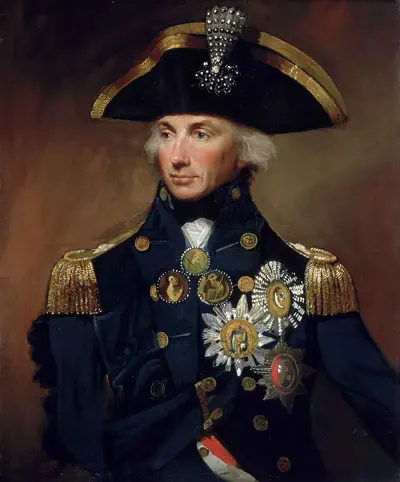
Vice-Admiral Horatio Nelson, 1st Viscount Nelson, 1st Duke of Bronté, KB, also known simply as Admiral Nelson, was an English flag officer in the Royal Navy. His inspirational leadership, grasp of strategy, and unconventional tactics brought about a number of decisive British naval victories, particularly during the Napoleonic Wars. He was wounded in combat, losing sight in one eye in Corsica at the age of 35, and most of one arm in the unsuccessful attempt to conquer Santa Cruz de Tenerife when he was 38. He was fatally shot at the Battle of Trafalgar in 1805.
