Frederick Douglass Quotes
I would welcome the news that the slaves had risen.
This fear was great among many who were abolitionists as potentially there might be mass slaughter of all Southern whites.
Frederick Douglasss, ~1817-1895, Abolitionist & Editor, Recorder of Deeds, District of Columbia, U. S. Minister to Haiti, Speech, Faneuil, Boston
Sourced by: Eigen's Political and Historical Quotations


She was one of the early abolitionists. Despite the Southern attempted repression of information of slave resistance, some of the facts emerged and were well known in the North. The South tried to suppress these incidents lest other slaves get ideas from it. Also the Southerners often maintained that Africa was so primitive and underdeveloped, that the slaves were better off in America; these actions of rebellion belied this notion.

This is an important quotation because it shows that slavery was the principle reason that the South succeeded and began their rebellion. In the early 20th century, there was a movement to make the Confederacy and the rebellion more noble by promoting the idea that the Civil War was fought by the South for more lofty reasons such as States Rights, Original Construction, different economic philosophies and the like. This was a more noble cause then the right to deny other human beings their rights, to own other human beings who they could beat, torture, sexually use and even murder them was a pretty selfish and demeaning reason to have started a rebellion that would then cost more Americans their lives than any other American conflict. The succession documents and others of the Southern States and the Confederacy make it clear that slavery was THE issue and fleeting references to any of the others were only made to complain about the potential effect on abolition and the refusal of the abolitionist states to cease aiding and protecting fugitive slaves.


Louis Napoleon Bonaparte. The “colonies” to which we was referring were the French Colonies in the Caribbean—particularly Haiti. The Black slaves had revolted against the slave-owners and had taken over all positions of authority and wore the uniforms and symbols of power including the epaulettes—the gold braid shoulder pieces that were symbols of high rank in military and diplomatic uniforms which were worn on all official occasions. Napoleon never did make good on his vow. He had many more problems with his own wars and governance in Europe. This quote does demonstrate the racism that existed in supposedly tolerant France.

The point about the negroes who were born into American slavery being less aggressive than those captured and transported to America is often overlooked. Slavery not only was cruel, moral, and inhuman in its own right, but also took its toll over generations as a result of the psychological effects of the terror of slavery. Despite these, it is amazing how resiliant the American Blacks were under those circumstances. in some cases one or two saves escaped after committing a violent act as they had little to lose for trying as they wold be killed if caught. A few of these escaped to the North and others reached Southern Cities like Charleston where there was a small free black community in which they could be absorbed.

Southerners complained that abolitionists were advocating revolution. While most did not, some did advocate mass rebellion. The fact that Remond was himself a Black, created even more distress to the South.
During the 1830’s the debate over whether the British Empire should abolish slavery was revived and caused much unrest, It illustrates the total incompatibility between slavery and literacy & education.

Christian had just briefed the President about the riots in many cities after the assassination of Martin Luther King. Christian had expressed surprise that the Blacks were so violent.


This was part of his presentation to Northern influential business men showing them what he claimed was the New South. He was particularly complimentary about the negro Christian viewpoint that inhibited revenge or retaliation for their terrible treatment. The favorable lines about Negroes were well received by Northerners. However, they were mostly unaware of his racist views he expressed when in the South. See Quotation 643649.

Jefferson was an enigma with respect to slavery. Whereas he always abhorred it in his writings, and argued for an end to slavery, he maintained slaves himself and never did free them, unlike Washington, who spoke on the subject much less, but left orders in his will that all slaves were to be set free.

This law required the treatment of Blacks as whites were then treated with respect to indentured servitude—a limit of 10 years after which the person would be free. However, this law was poorly enforced. The “General Court” was the name for the legislature of the Rhode Island colony.
In early New England the General Court served as both a legislature and a judiciary before separation of powers was introduced. 5 years later the Court banned importing African slaves at all. While slavery was not common in Rhode Island, the laws was not seriously enforced on those who would defy them. It does represent a public anti-slavery sentiment that existed in Early America. It would take 200 years for Rhode Island to finally eliminate all forms of slavery.


It, would automatically emancipate all children born to slaves thereafter. It did not pass. The quote is given as evidence of Jefferson’s attempts to eliminate slavery but is in marked contrast to the fact that he never freed his own slaves nor emancipated slave children (including possibly his own child with his slave Sally Hemmings). In addition, compare this with {629765} and {630991}.
This prophecy written in the later years of Jefferson’s life turned out to be all too true. St. Domingo was an Island in the Caribbean where slavery produced a bloody war. The American Civil War would be far worse.

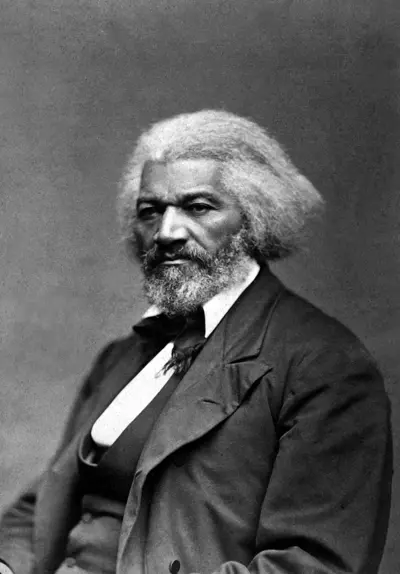
Frederick Douglass was an American social reformer, abolitionist, orator, writer, and statesman. After escaping from slavery in Maryland, he became a national leader of the abolitionist movement in Massachusetts and New York, becoming famous for his oratory and incisive antislavery writings. Accordingly, he was described by abolitionists in his time as a living counterexample to slaveholders' arguments that slaves lacked the intellectual capacity to function as independent American citizens. Likewise, Northerners at the time found it hard to believe that such a great orator had once been a slave.
