Rutherford B. Hayes Quotes
I grow more conservative every day on the question of removals. On ex parte statements, I have made mistakes in removing men who, perhaps, ought to have been retained, and in appointing wrong men. Not many removals have been made. Less than any Administration since John Q. Adams. But I shall be more cautious in future; make removals only in clear cases, and appoint only on the best and fullest evidence of fitness.
Hayes was a Civil Service reformer. After the presidency of John Quincy Adams, Andrew Jackson and subsequent Presidents fired large numbers of public servants—even minor poitions and replaced them with supporters. Hayes stopped that practice and initiated civil servce reform.
Rutherford B. Hayes, 1822-1893, 19th President of the United States (Republican, OH), Diary, August 5, 1877
Sourced by: Eigen's Political and Historical Quotations


After the United States Military victory at the Beginning of the Iraq War, the Bush administration operated under the neoconservative view that the Iraqis wanted a democracy and freedom and saw the occupation and reconstruction of Iraq as an opportunity to apply extreme conservative principles in the construction of a modern democracy in the Middle East. Bush appointed one of his political supporters and conservative ideologue as the head of the occupation authority and almost all of the many positions to rebuild Iraq was filled with conservative ideologues almost all of whom had no previous practical experience in the area of their new responsibility, and had not diplomatic skills or experience in Iraq, the Middle East. Almost none spoke Arabic or knew anything about Islamic culture. The occupation was a disaster, and the deadly phase of the Iraq war broke out.

While the George W. Bush administration polarized the civil service by appointing ideological zealots without regard to competence and qualifications, Conservative Australian Prime Minister John Howard, had actually done the same thing before him.


2nd Viscount Melbourne. The pressure for appointments to key positions has always been a problem in modern America. What is surprising in this quotation is that the exact same problems existed in a constitutional monarchy in 19th century England. Note the formality of the form of address in letters to the Queen. Lamb refers to himself in the third person by his aristocratic title, “Lord Melboure”, rather than the first person “I” which would have been too familiar in the address of the monarch. Many English communications with the King or Queen, even in modern times, is this archaic form of address.


This famous quotation was only partly original. The most famous part, "Facts are stubborn things" was earlier used by the French Writer, Alain René Le Sage in Gil Blas


This was the origin of the first part of John Adams famous quoation {310967}
The Inspector General of the Justice Department and a Congressional committee found his actions illegal. Schlozman, a Republican Assistant Attorney General, had violated the Civil Service Reform Act by hiring attorneys on the basis of their political affiliation and later made false statements in his sworn testimony to Congress about his hiring decisions. He wanted people who he could count on to follow his lead and not prevent Southern States from changing their election laws and thus be able to discriminate against Blacks in voting, as was required by the Voting Rights Act of 1965. This quotation is often cited by Civil Service supporters to show what can happen when a political appointee can fire government employees and replace them with people who will agree with him on matters of political ideology.

This law established the Civil Service Commission and for the first time in American History required open examinations for the appointing of government employees. Japan had required examinations for civil service for hundreds of years. President Garfield had called for such legislation in his inaugural address {586804} 2 years earlier. This was the legislation that implemented it.


The then President Rutherford Hayes was an aggressive reform advocate who had instituted Civil Service reform which eliminated a large proportion of the patronage appointments of the Federal Government. Conkling a classic political boss of the era felt that Hayes’ motives were just pandering to voters and saw him as a scoundrel. See {589693}.

The rotation-in-office principle, first introduced by Jefferson, brought this observation from the then Secretary of State:
Upon learning that his son, John Quincy Adams, had been chosen President of the United States, the former President remarked:


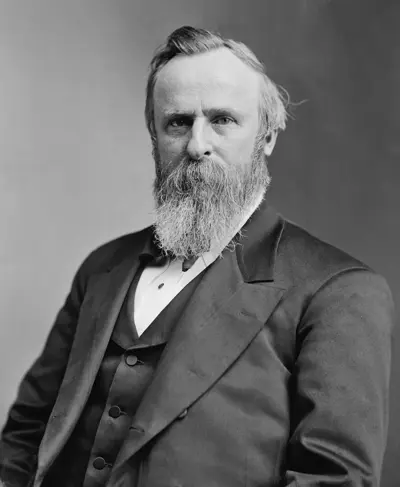
Rutherford Birchard Hayes was an American politician and attorney who served as the 19th president of the United States from 1877 to 1881, after serving in the U.S. House of Representatives and as governor of Ohio. A lawyer and staunch abolitionist, he had defended refugee slaves in court proceedings during the antebellum years. He negotiated the political agreement to end federal support of Reconstruction.
