John Quincy Adams Quotes
Neither truth, reason, nor justice consists in stubbornness of assertion, nor in the repetition of error.
John Quincy Adams, 1767-1848, 6th President of the United States (Independent, MA), Communiqué to Spanish Ambassador Luis de Onis y Gonzales, January 16, 1818
Sourced by: Eigen's Political and Historical Quotations


Ibn al-Nafis was one of the great scientists of all time. He analyzed the human heart, lungs, and circulatory system. This quotation is often given by Muslim modernists and reformers to illustrate that Islam at one time was open to new knowledge, dissent, ideas of all kinds. A century later, Islam closed intellectually and later and even today, Muslims are killed for what became heresy. Truth became determined by the Koran and the words of The Prophet only, Christianity and the Church imposed a similar restrictive view of truth using the Bible and Jesus. However, the Reformation and modernity led Christianity to merge and adopt the more modern and scientific view with the exception of some Christian fundamentalists. Islam had the modern view and abandoned it causing the many educated Islamic reformers and modernists of today great difficulty in changing the culture and laws as a whole.

Most politicians would never do this. Ideologues rarely analyze their beliefs. Pragmatic politicians are fearful of being called a flip flopper with no core principles. However, some politicians follow this advice. For example, Abraham Lincoln and Franklin Delano Roosevelt were both among the rare politicians who would frequently change positions as they learned more. See John Maynard Keynes {619441} for a personal statement of this principle and {636175} for a modern view.


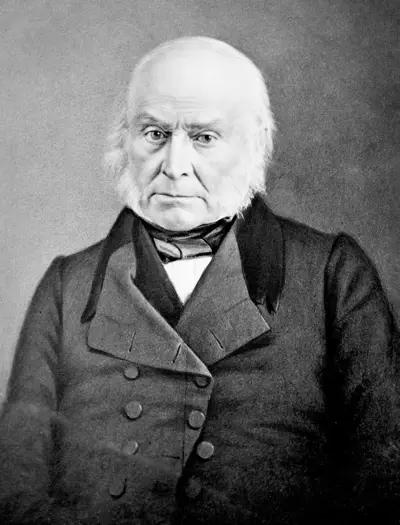
John Quincy Adams was an American statesman, diplomat, lawyer, and diarist who served as the sixth president of the United States, from 1825 to 1829. He previously served as the eighth United States Secretary of State from 1817 to 1825. During his long diplomatic and political career, Adams also served as an ambassador, and as a member of the United States Senate and House of Representatives representing Massachusetts. He was the eldest son of John Adams, who served as the second U.S. president from 1797 to 1801, and First Lady Abigail Adams. Initially a Federalist like his father, he won election to the presidency as a member of the Democratic-Republican Party, and in the mid-1830s became affiliated with the Whig Party.
