John Marshall Quotes
The constitution is either a superior paramount law, unchangeable by ordinary means, or it is on a level with ordinary legislative acts, alterable when the legislature shall please to alter it. It is emphatically the province and duty of the judicial department to say what the law is. This is the very essence of judicial duty.
Marshall, John. Marbury v. Madison. 5 U.S. (1 Cranch) 137. Supreme Court of the United States. 1803.


This concept of balance of power and the equal role of the judiciary is actually quite rare. Even in Parliamentary democracies the parliament can override any court interpretation. In England, the upper legislative house, the House of Lords, actually serves as the nation’s highest or supreme court. And these “Law Lords” can override all regular judicial bodies.

See John Marshall's later (1803) use of the concept and term "repugnant." {606483}


Marshall did not crate this concept or some its phraseology out of whole cloth. See Rufus King {610245} for a Constitutional Convention basis for the statement.


The view that the Supreme Court was the final arbiter of constitutional controversies was not held in early America.
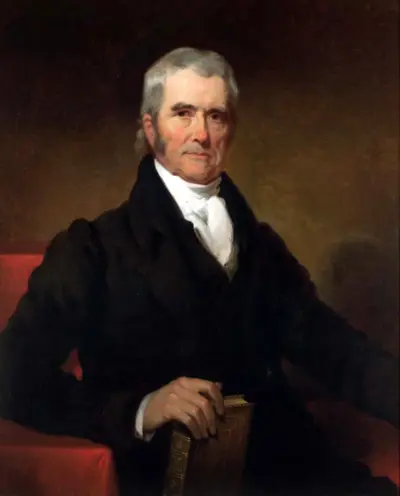
John Marshall was an American politician and lawyer who served as the fourth Chief Justice of the United States from 1801 to 1835. Marshall remains the longest-serving chief justice and fourth-longest serving justice in Supreme Court history, and he is widely regarded as one of the most influential justices to ever sit on the Supreme Court. Prior to joining the Supreme Court (and for one month simultaneous to his tenure as Chief Justice), Marshall served as the United States Secretary of State under President John Adams.
