Rufus King Quotes
Judges will have the expounding of those laws when they come before them; and they will no doubt stop the operation of such as shall appear repugnant to the constitution.
See John Marshall's later (1803) use of the concept and term "repugnant." {606483}
Rufus King, 1755-1827, Member of Continental Congress, Massachusetts Delegate to the Constitutional Convention, U. S. Senator (New York), U. S. Minister to Great Britain, Constitutional Convention debate, 1787
Sourced by: Eigen's Political and Historical Quotations

Marshall did not crate this concept or some its phraseology out of whole cloth. See Rufus King {610245} for a Constitutional Convention basis for the statement.


One of the conundrums of our constitutional system is who has the last word as to what the Constitution means. Essentially it is the judicial branch headed by the Supreme Court. But there are those who believe that the current popular majority should have a say in what is or is not constitutional. If so the legislative branch should have the last word. Still others say that the President is the only person elected by ALL the people, so his opinion most reflects the will of the public. And then there are most who argue that the Constitutional system was created just to avoid the power of currently popular majorities, and the courts should decide based on the Constitution itself. So the statement has very little meaning except that Phillips thinks that the courts have too much power. Whoever gets to decide what is or is not Constitutional will be accused of being “over” the Constitution by those who don’t like the decisions. In our system, that is the courts.

Cummings was arguing against a Constitutional amendment. His alternative led to Roosevelt's court packing schema.

This concept of balance of power and the equal role of the judiciary is actually quite rare. Even in Parliamentary democracies the parliament can override any court interpretation. In England, the upper legislative house, the House of Lords, actually serves as the nation’s highest or supreme court. And these “Law Lords” can override all regular judicial bodies.
Marshall is famous for, as Chief Justice, establishing the principle that the Judiciary can override Congress and the Executive in determining Constitutionality. However, as this quotation illustrates this principle had been discussed in open debate on the ratification of the Constitution. It was not simply a grab for power by a Chief justice; he uttered this quotation long before he ever suspected he would be a judge but actually spent much of his career in the executive and legislative branch of government.


Jefferson’s fears were later reinforced by John Marshall in Marbury v. Madison {606468}


Referring to the Brown v. Board of Education, the Topeka, KS, Supreme Court school desegregation decision:

Barstow the Democratic Governor who had no serious opposition in 1853 found himself challenged for reelection by Coles Bashford of the new Republican Party. The Board of Canvassers reported that Governor Barstow had won reelection but by less than 200 votes in the whole state. The Republicans charged that there had been fraud in some of the rural districts and petitioned the Wisconsin Supreme Court which ruled that nonexistent precincts had indeed voted for the Governor. The Barstow forces however refused to recognize the decisions of the court claiming that the court had no jurisdiction over the Board of Canvassers who were part of the executive branch. The Republicans held their own inauguration and two men claimed to be Governor. But the Governor claimed that the state constitution did not give the court any authority to deal with the crisis, He even called out the State Militia to maintain his office and intimidate the Supreme Court and keep the “other governor” from the state house. Nonetheless the court ruled that even the Governor had to obey the law and the Supreme Court would determine what the law was. Barstow finally “resigned.” See {587915} & {587914}.

The president was asked if he supported the Supreme court's school desegregation decision:


This shameful quotation was shocking to most readers. It is subject to two interpretations: One that judges who did not rule on Constitutional issues the way conservative extremists wanted would come to physical harm. The other, that conservatives should pressure judges by withholding appropriations for the courts, impeachments and recall elections where they exist, as well as funding potential opponents for those jurisdictions where judges are elected. Both meanings were disgraceful in the view of most Americans. Later, DeLay was convicted and sentenced to jail for money laundering and illegally spending and raising campaign funds. He was also reprimanded by the House Ethics Committee for unethical methods of fund raising for other earlier actions.


In modern times almost all countries have written constitutions. And almost all of those constitutions appear to be democratic. Many have been taken from the United States Constitution. However, most of the countries are not real democracies as they do not enforce their own constitutions. For example, in Egypt, the constitution guarantees women equal rights to men. There are many female attorneys. However, the notion of a female judge is too much for the sexist culture. So regardless of what the constitution says, it is not enforced with respect to female judges. When Smyth gave his lecture, constitutions were just getting popular. He was prescient enough to realize that a constitution to be effective must conform to the belief structure of most of the population and the constitution most be administered as well as written.
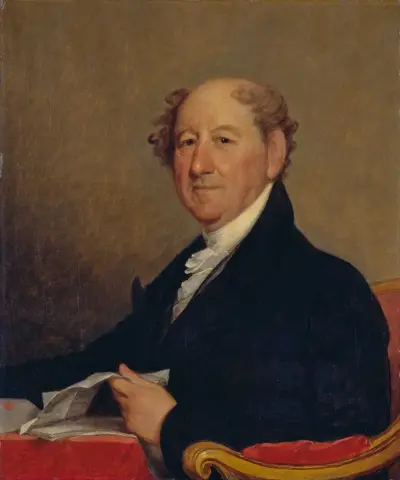
- Born: March 24, 1755
- Died: April 29, 1827
- Nationality: American
- Profession: Lawyer
Rufus King was an American lawyer, politician, and diplomat. He was a delegate for Massachusetts to the Continental Congress and the Philadelphia Convention and was one of the signers of the United States Constitution in 1787. After formation of the new Congress he represented New York in the United States Senate. He emerged as a leading member of the Federalist Party, serving as the party's last presidential nominee in the 1816 presidential election.
