William Smyth Quotes
For it is always to be remembered that it is the spirit with which a constitution is in practice administered, that is the great point of consequence, far more than the letter of the law
In modern times almost all countries have written constitutions. And almost all of those constitutions appear to be democratic. Many have been taken from the United States Constitution. However, most of the countries are not real democracies as they do not enforce their own constitutions. For example, in Egypt, the constitution guarantees women equal rights to men. There are many female attorneys. However, the notion of a female judge is too much for the sexist culture. So regardless of what the constitution says, it is not enforced with respect to female judges. When Smyth gave his lecture, constitutions were just getting popular. He was prescient enough to realize that a constitution to be effective must conform to the belief structure of most of the population and the constitution most be administered as well as written.
William Smyth, 1765–1849, English Historian, Lectures on Modern History, published 1854
Sourced by: Eigen's Political and Historical Quotations

Powell was the Secretary of State and Addington kept advising the administration that as long as the President was acting in defense of the country in his capacity as Commander in Chief, he did not have to obey any existing laws that had been Constitutionally passed which in the opinion of the President restricted or limited the President or the executive branch. Addington was an attorney and Assistant to the Vice President, but he was given much responsibility for administration policy. Powell the Secretary of State of the Administration could not have disagreed more and although most politicians including Republicans disagreed with the Addington thesis, Powell was one of the few Republicans to criticize the Addington position.


See John Marshall's later (1803) use of the concept and term "repugnant." {606483}


The president was asked if he supported the Supreme court's school desegregation decision:


Sunday Excise Laws, sometimes called “Blue Laws”, prohibited commercial activity on Sunday, the day most Christians believe to be the Sabbath. Then such laws had not been constitutionally tested and when the were later were they were all found to be unconstitutional. Some Christian sects believe that Saturday is the Sabbath as do most Jews. Muslims believe Friday is the Sabbath. So any state determination on the Sabbath favors some religious viewpoint and discriminates against others. Today, decisions about Sabbath are left to individual consumers and store owners.


Barstow the Democratic Governor who had no serious opposition in 1853 found himself challenged for reelection by Coles Bashford of the new Republican Party. The Board of Canvassers reported that Governor Barstow had won reelection but by less than 200 votes in the whole state. The Republicans charged that there had been fraud in some of the rural districts and petitioned the Wisconsin Supreme Court which ruled that nonexistent precincts had indeed voted for the Governor. The Barstow forces however refused to recognize the decisions of the court claiming that the court had no jurisdiction over the Board of Canvassers who were part of the executive branch. The Republicans held their own inauguration and two men claimed to be Governor. But the Governor claimed that the state constitution did not give the court any authority to deal with the crisis, He even called out the State Militia to maintain his office and intimidate the Supreme Court and keep the “other governor” from the state house. Nonetheless the court ruled that even the Governor had to obey the law and the Supreme Court would determine what the law was. Barstow finally “resigned.” See {587915} & {587914}.


Cummings was arguing against a Constitutional amendment. His alternative led to Roosevelt's court packing schema.


Despite Ziglar’s and other officials pointing out the illegality, illegal sweeps and arrests were made without warrants or constitutional requirements.


This quotation is particularly important because it summarizes one of two opposite schools or thought regarding judicial interpretation of the Constitution that politicians have been arguing about since the Supreme Court first sat. The other is Original Intent where only the original intentions of the writers and ratifiers of the Constitution should be considered—assuming that it can be determined.


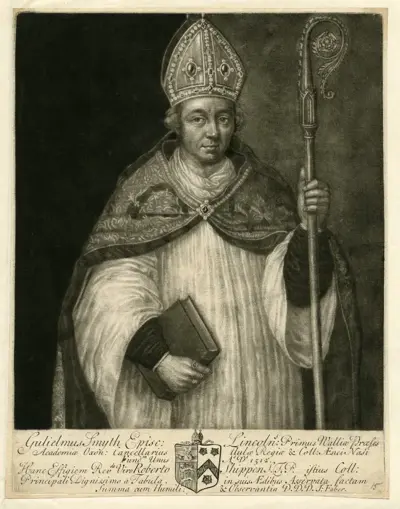
William Smyth (or Smith) was Bishop of Coventry and Lichfield from 1493 to 1496 and then Bishop of Lincoln until his death. He held political offices, the most important being Lord President of the Council of Wales and the Marches. He became very wealthy and was a benefactor of a number of institutions. He was a co-founder of Brasenose College, Oxford and endowed a grammar school in the village of his birth in Lancashire.
