Colin Powell Quotes
David Addington does not believe in the Constitution
Powell was the Secretary of State and Addington kept advising the administration that as long as the President was acting in defense of the country in his capacity as Commander in Chief, he did not have to obey any existing laws that had been Constitutionally passed which in the opinion of the President restricted or limited the President or the executive branch. Addington was an attorney and Assistant to the Vice President, but he was given much responsibility for administration policy. Powell the Secretary of State of the Administration could not have disagreed more and although most politicians including Republicans disagreed with the Addington thesis, Powell was one of the few Republicans to criticize the Addington position.
Colin Powell, U. S. Secretary of State (Republican), General & Chairman of the Joint Chief's of Staff, White House Chief of Staff, Quoted on The Charlie Rose Show, August 13, 2008
Sourced by: Eigen's Political and Historical Quotations

President George W. Bush had ignored a federal law and tapped the phones of Americans without probable cause and a warrant issued by a court. The President’s defenders argued that the President, as Commander in Chief, has the Constitutional responsibility to lead the military and protect the nation. Intelligence gathering is part of military activity. Therefore the intelligence gathering is a Constitutional duty and the Congress, under the separation of powers doctrine, may not interfere with the President’s Constitutional Duty to conduct intelligence. Under this doctrine, the President need not obey laws that he believes impinge on his management of the war effort and the defense of the nation. Most legal scholars believe that this argument is nonsense, but the George W. Bush administration has stated the doctrine and it was the subject of much litigation.


This quotation is particularly important because it summarizes one of two opposite schools or thought regarding judicial interpretation of the Constitution that politicians have been arguing about since the Supreme Court first sat. The other is Original Intent where only the original intentions of the writers and ratifiers of the Constitution should be considered—assuming that it can be determined.

The Chief Justice at the time was an ultra-conservative judge, who together with his 8 colleagues—all conservative—had blocked much of the democratic and progressive legislation that the Congress had passed. FDR had a much different legal and philosophical view of the Constitution than the Chief Justice, and the court would declare much of his New Deal legislation, passed in the emergency of the Great Depression, unconstitutional. Almost all of those “unconstitutional” things were years later passed again and this time a more modern court found they were Constitutional.


Cummings was arguing against a Constitutional amendment. His alternative led to Roosevelt's court packing schema.


This was an insult to the George W. Bush administration which had stretched the Constitution more so than any previous administration, had asserted Presidential powers that had never been asserted before and had had several of its more controversial policies and practices overturned by the Supreme Court.


The president was asked if he supported the Supreme court's school desegregation decision:

In modern times almost all countries have written constitutions. And almost all of those constitutions appear to be democratic. Many have been taken from the United States Constitution. However, most of the countries are not real democracies as they do not enforce their own constitutions. For example, in Egypt, the constitution guarantees women equal rights to men. There are many female attorneys. However, the notion of a female judge is too much for the sexist culture. So regardless of what the constitution says, it is not enforced with respect to female judges. When Smyth gave his lecture, constitutions were just getting popular. He was prescient enough to realize that a constitution to be effective must conform to the belief structure of most of the population and the constitution most be administered as well as written.


Marshall is famous for, as Chief Justice, establishing the principle that the Judiciary can override Congress and the Executive in determining Constitutionality. However, as this quotation illustrates this principle had been discussed in open debate on the ratification of the Constitution. It was not simply a grab for power by a Chief justice; he uttered this quotation long before he ever suspected he would be a judge but actually spent much of his career in the executive and legislative branch of government.


Barstow the Democratic Governor who had no serious opposition in 1853 found himself challenged for reelection by Coles Bashford of the new Republican Party. The Board of Canvassers reported that Governor Barstow had won reelection but by less than 200 votes in the whole state. The Republicans charged that there had been fraud in some of the rural districts and petitioned the Wisconsin Supreme Court which ruled that nonexistent precincts had indeed voted for the Governor. The Barstow forces however refused to recognize the decisions of the court claiming that the court had no jurisdiction over the Board of Canvassers who were part of the executive branch. The Republicans held their own inauguration and two men claimed to be Governor. But the Governor claimed that the state constitution did not give the court any authority to deal with the crisis, He even called out the State Militia to maintain his office and intimidate the Supreme Court and keep the “other governor” from the state house. Nonetheless the court ruled that even the Governor had to obey the law and the Supreme Court would determine what the law was. Barstow finally “resigned.” See {587915} & {587914}.

The Presidential election of 1800 produced a crisis even greater than that of 2000. There was an Electoral College tie between Thomas Jefferson and Aaron Burr—both of the same party, Democratic Republicans. The Federalist Party led by President John Adams had been totally rejected by the voters and Adams was in third place. However, the Federalists saw an opportunity of maintaining the Presidency anyway. The Constitution threw the election into the House of Representatives with each State delegation having a single vote. In the House, the Federalists had parity with Jefferson’s party which resulted in 35 tie votes. Finally, Congressman Bayard, the sole Congressman from Delaware, withheld his vote on the 36th ballot, thereby electing Thomas Jefferson of the opposition party. His reason was:


The view that the Supreme Court was the final arbiter of constitutional controversies was not held in early America.
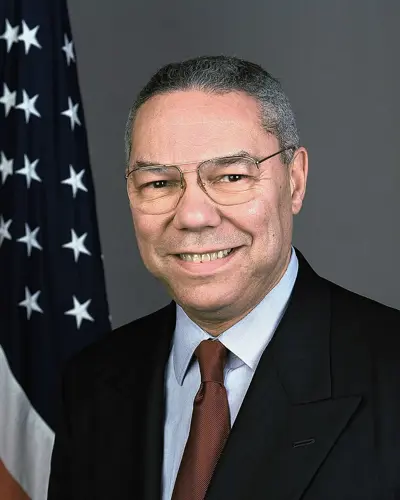
Colin Luther Powell is an American politician, diplomat and retired four-star general who served as the 65th United States Secretary of State from 2001 to 2005. Powell was the first African-American Secretary of State. Prior to the election of Barack Obama as president in 2008, Powell and his successor, Condoleezza Rice, were the highest-ranking African Americans in the history of the federal executive branch (by virtue of the Secretary of State standing fourth in the presidential line of succession). Powell served as the 16th United States National Security Advisor from 1987 to 1989 and as the 12th Chairman of the Joint Chiefs of Staff from 1989 to 1993.
