Antonin Scalia Quotes
I think it is up to the judge to say what the Constitution provided, even if what it provided is not the best answer, even if you think it should be amended. If that's what it says, that's what it says.
Antonin Scalia, U. S. Supreme Court Justice, Lecture, American University, 2005
Sourced by: Eigen's Political and Historical Quotations

This quotation is particularly important because it summarizes one of two opposite schools or thought regarding judicial interpretation of the Constitution that politicians have been arguing about since the Supreme Court first sat. The other is Original Intent where only the original intentions of the writers and ratifiers of the Constitution should be considered—assuming that it can be determined.

Cummings was arguing against a Constitutional amendment. His alternative led to Roosevelt's court packing schema.


See John Marshall's later (1803) use of the concept and term "repugnant." {606483}


Marshall is famous for, as Chief Justice, establishing the principle that the Judiciary can override Congress and the Executive in determining Constitutionality. However, as this quotation illustrates this principle had been discussed in open debate on the ratification of the Constitution. It was not simply a grab for power by a Chief justice; he uttered this quotation long before he ever suspected he would be a judge but actually spent much of his career in the executive and legislative branch of government.

Referring to the Brown v. Board of Education, the Topeka, KS, Supreme Court school desegregation decision:


Powell was the Secretary of State and Addington kept advising the administration that as long as the President was acting in defense of the country in his capacity as Commander in Chief, he did not have to obey any existing laws that had been Constitutionally passed which in the opinion of the President restricted or limited the President or the executive branch. Addington was an attorney and Assistant to the Vice President, but he was given much responsibility for administration policy. Powell the Secretary of State of the Administration could not have disagreed more and although most politicians including Republicans disagreed with the Addington thesis, Powell was one of the few Republicans to criticize the Addington position.

He uses the term, “Non-interpretivism”, in a judge’s decision to indicate a judge who does not accept the interpretation of the Constitution as written and intended by the framers. His bias is a conservative one and this is how he views decisions that he does not like. When liberals see an opinion with which they do not agree, they also very often accuse the judge of activism and not adhering to the framer’s intentions. Generally it is a question of “whose ox is gored?”

The Chief Justice at the time was an ultra-conservative judge, who together with his 8 colleagues—all conservative—had blocked much of the democratic and progressive legislation that the Congress had passed. FDR had a much different legal and philosophical view of the Constitution than the Chief Justice, and the court would declare much of his New Deal legislation, passed in the emergency of the Great Depression, unconstitutional. Almost all of those “unconstitutional” things were years later passed again and this time a more modern court found they were Constitutional.
This concept of balance of power and the equal role of the judiciary is actually quite rare. Even in Parliamentary democracies the parliament can override any court interpretation. In England, the upper legislative house, the House of Lords, actually serves as the nation’s highest or supreme court. And these “Law Lords” can override all regular judicial bodies.
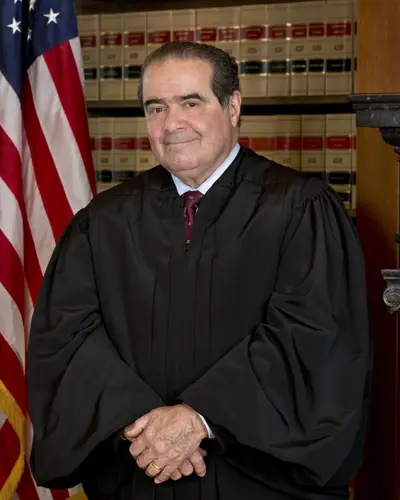
Antonin Gregory Scalia was an American jurist who served as an associate justice of the Supreme Court of the United States from 1986 until his death in 2016. He was described as the intellectual anchor for the originalist and textualist position in the Court's conservative wing. For catalyzing an originalist and textualist movement in American law, he has been described as one of the most influential jurists of the twentieth century, and one of the most important justices in the Supreme Court's history. Scalia was posthumously awarded the Presidential Medal of Freedom in 2018 by President Donald Trump, and the Antonin Scalia Law School at George Mason University was named in his honor.
