Salmon P. Chase Quotes
[The] fundamental principal of all just legislation [is] that the legislature shall not take the property of A and give it to B.
Salmon P. Chase, 1808-1873, U. S. Senator (Free-Soil & Republican, OH), Ohio Governor (Free-Soil), U. S. Secretary of the Treasury, Chief Justice, U. S. Supreme Court, Legal Tender Cases, Dissent, 1871
Sourced by: Eigen's Political and Historical Quotations


To Mises, “interventionism” is any government action that affects business and businessmen and women. In a large complex society, virtually every government action will benefit some more than others while harming some more than others. There are almost always winners and losers as a result of every government action. Most political philosophers see justice and fairness in benefitting the majority of people most of the time. However Mises and others observe that in a large complex society, in an absolute sense, politics and government can never be fair and just to all.


There are many methods of voting in a legislative body. “Viva Voce” is Latin for “by Voice” and is often called a “Voice Vote”. Voting by ballot takes longer but had the advantage or disadvantage of secrecy. The theory was that if the New York Legislators could vote in a secret ballot, the lobbies and special interests would not be as influential since they would never know for sure—unless there were a unanimous vote—how any particular legislator voted. A further advantage is that Party Discipline could not be imposed and parties or “factions” as they were then called would be less powerful—a great concern of all the patriots who tended to distrust parties. The disadvantage was that the people who elected the legislator would never know how he voted. Note the frank admission that this was an “experiment”. Americans of the era realized that almost everything they were doing was a political experiment and this introduced a pragmatic force into structure and procedures of American politics.

In the English system there is no “separation of powers”. Parliament makes the laws and its ministers execute them. The highest judges are members of Parliament (the House of Lords) as well. So Lord Bereford was in the legislature when the statute was debated and passed.


This is the earliest surviving attempt of the Romans to formulate a legal code.
This Cahier was the consensus of the Clergy of Blois in 1789. There were cahiers of several provinces of France—some by the clergy, some by the nobles. What is fascinating is the emergence of many of the pre-revolutionary French concepts. The example of the American revolution and its principles was known throughout the educated classes of France.


Eleven years later, abuses were so great and things were so bad that Gladstone reversed himself and the Wyndam Act to regulate Irish rents was passed.

Not the current Daily News. He was very critical of the NY State Legislature changing the laws affecting wills and inheritance in order to benefit some special interest when there was a profound effect on millions of other people that had not been considered by the legislature, the majority of which had never even read the legislation, but were following party leader’s instructions or that of powerful committee chairmen.
This is a classic type of fallacious political logic. The author claims that there are no powers in the constitution to make laws in a number of important areas of our society. What is true, is that there is no explicitly and uniquely specified statements in the Constitution regarding the areas he specified (and some he didn’t like education). However the power to make laws in these areas comes from the “Commerce Clause” where the Federal Government was given the power to regulate Interstate Commerce. And that is what the Federal Government does make laws about. Food that is sold in the state where it is grown is regulated by the states. But interstate agriculture is. Medicines and weapons are also sold and transported in interstate commerce. Even housing is in part covered as financing and mortgages, building materials, working conditions of the building companies are part of Interstate Commerce. A succession of Congresses have recognized this and so has every Supreme Court in our history. McManus however believes that all these legislators and judges have been wrong and worse, part of a conspiracy to subvert the Constitution. See {630683} for his tendency to see conspiracies in politics.


The Czar, a total autocrat, was out of touch with most of the civilized world. Under much pressure from his advisors who realized that there was much unhappiness with an autocracy, the Czar made this reform which seemed a major concession and was very much welcomed by the people. However, it had relatively little practical effect. The Duma could not make laws, they could only ratify those made by the Czar and his ministers. However, few members of the Duma were willing to vote against a measure that the Czar wanted. It had no practical effect on improving the standard of living and the economic development of a backward empire.


the authors of the Constitution

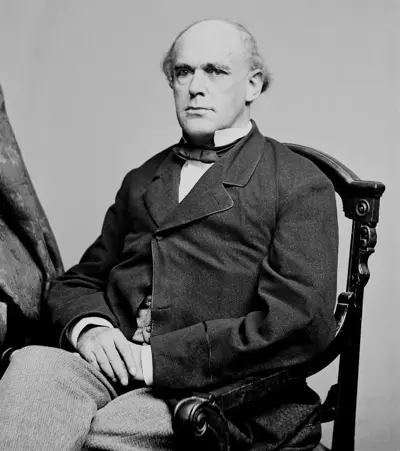
Salmon Portland Chase was a U.S. politician and jurist who served as the sixth Chief Justice of the United States. He also served as the 23rd Governor of Ohio, represented Ohio in the United States Senate, and served as the 25th United States Secretary of the Treasury. Chase was therefore one of a few U.S. politicians who served in all three branches of the federal government.
