New York State Quotes
And whereas it is of great importance to the safety of this State that peace and amity with the Indians within the same be at all times supported and maintained; and whereas the frauds too often practiced towards the said Indians, in contracts made for their lands, have, in diverse instances, been productive of dangerous discontents and animosities: Be it ordained, that no purchases or contracts for the sale of lands, made since the fourteenth day of October, in the year of our Lord one thousand seven hundred and seventy-five, or which may hereafter be made with or of the said Indians, within the limits of this State, shall be binding on the said Indians, or deemed valid, unless made under the authority and with the consent of the legislature of this State.
This clause protecting and restoring Indian lands was one of the reasons that New York had less hostility between Indians and whites than many other states did.
New York, State Constitution, April 20, 1777
Sourced by: Eigen's Political and Historical Quotations

There was then legislation proposed to to nullify a number of Indian treaties. Indians themselves were divided as to the desirability. Mrs. Roosevelt favored negotiations and discussions with each tribe separately regarding their treaties as opposed to the proposed legislation which treated the tribes monolithically when indeed they were 500 separate tribes with different cultures, needs and desires.

This is a particularly good historical quotation describing the state of the Native Americans and the different policies that had been adopted before and after the American Revolution. The President candidly admits there were unexpected consequences to American efforts after the Revolution and that some of the original objectives for the Indians had not been successful. He states some of the problems and notes the challenge ahead to resolve them equitably. After Adams was succeeded by Andrew Jackson, the new President and the forces he represented decided that the land and sovereignty over the land for America was more important than the other objectives which had not been successfully met very often. The age of rank discrimination and Indian removal began.

Most Indian treaties were “negotiated” with the implicit or explicit threat of force against the Indians.
The Iroquois were among the most sophisticated of the North American Indian Tribes. They also were highly assimilated into the American society. In the next decades, they would switch their political position when New York State provided better legal guarantees for Iroquois land than the Federal Government. By the end of the 20th Century, led by the Iroquois, the Indian residents of New York State had the same level of earnings as the white man—and that was with NO INDIAN GAMING.
This was passed in 1787 before the Constitution had become operative, but was then ratified by Congress in 1789. It was one of the first acts of our new nation, and one of the most frequently violated throughout our history.


In the midst of the French & Indian Wars, the Board of Trade drafted the royal proclamation of October 7, 1763, forbidding the granting of lands in the vast interior, which was specifically reserved to the Indians. Most whites, themselves interested in land, saw this as a temporary expediency only. This quotation must be viewed in juxtaposition with his of 1767 on the subject: {624055}


Note that there was still a serious attempt to coexist with the Indians and to pay for lands that whites moved into. This would change radically in the administration of Andrew Jackson who would replace Adams.

Whereas most revolutions radically change the law from the preexisting laws, the American revolution essentially embraced most of the common law of England, English statutes and New York Colonial Statutes. The New York constitution reserved the right to change any of them, but the change Americans sought was partial and limited to certain areas. See {621430} for some examples of changes.
Many American leaders wanted to comply with and enforce the Indian treaties, but the remoteness made it difficult. There were always those whites who did not want to be restricted by Indian treaties who took advantage of the situation when there was a leader like Clinton who wanted to enforce the treaties. However in many cases, the American leadership really did not want to enforce the treaties and in some cases, as with President Andrew Jackson, wanted to abrogate the treaties with the Indians.

The treaty was signed by a number of people including the Navajo leaders but Sherman or his staff drafted most of it. Sherman also had the title then of Indian Peace Commissioner. This clause, together with Article V, {617991} guaranteed the territorial integrity to into the 21st century. The super majority requirement was key, preventing what happened to many other Indian land holdings which were sold off by individuals or so called chief’s who were not really representing the majority of the tribe.


Individual states passed laws that impinged on Indian rights and undid the effect of previous treaties. Some tribes complained to the President. In actuality, there was Federal legislation that preempted the states, but President Jackson, as a matter of policy allowed the state action.

Cass was negotiating with the Shawnees and Cherokees to persuade them to move to land west of the Mississippi. See John Henry Eaton for similar unkept promises.

Jackson’s policies regarding Indians set back all the work of the earlier Presidents and created facts on the ground and attitudes that vex us to this day. In this occasion he said very forthrightly that it was his intention to deny Indians title to ANY land in the then United States. His idea was to send all the Indians to the Oklahoma Indian Territory and establish reservations for them there. Of course, as the Western states joined the Union, the Whites wanted those Indian Lands as well. See {643150} for other Jackson views on Indian policy.

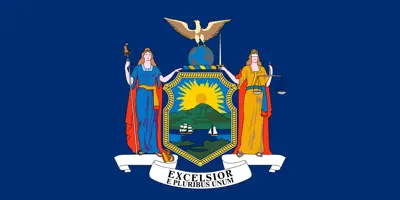
New York is a state in the Mid-Atlantic and Northeastern regions of the United States. It was one of the original thirteen colonies forming the United States. With a total area of 54,556 square miles (141,300 km2), New York is the 27th largest state; its population of more than 19 million people as of 2020 makes it the fourth most populous state in the U.S. The state is bordered by New Jersey and Pennsylvania to the south and Connecticut, Massachusetts, and Vermont to the east; it has a maritime border with Rhode Island, east of Long Island, as well as an international border with the Canadian provinces of Quebec to the north and Ontario to the northwest. It is sometimes referred to as New York State to distinguish it from New York City, which is its largest city.
