John Marshall Quotes
The government of the Union, though limited in its powers, is supreme within its sphere of action.
John Marshall, 1755-1835, Chief Justice of the U. S. Supreme Court, U. S. Congressman (Federalist, VA), U. S. Secretary of War, U. S. Secretary of State, McCulloch v. Maryland, 1819
Sourced by: Eigen's Political and Historical Quotations

The Grammar Curmudgeon. In most states there is a parallel question of the State government and the local government balance of powers.


Commonly referred to as the Kentucky Resolution. This concept of Nullification was one of the factors that aggravated the tensions leading to the Civil War. Were the individual States to be the arbiters of whether or not a Federal act was Constitutional or was it to be the Supreme Court.


Soon after Jackson's reelection, delegates from South Carolina, led by John C. Calhoun, moved quickly to declare "null, void, and no law" the Tariff Act of 1832. The president's reaction to the Ordinance of Nullification was swift.


President John Adams Alien and Sedition Acts were amongst the worst laws ever passed in America. It totally violated the First Amendment but at the time the Supreme Court had not ruled on the laws which prohibited criticizing the government. Ironically, it was Adams’s son, John Quincy Adams who finally led the repeal effort.


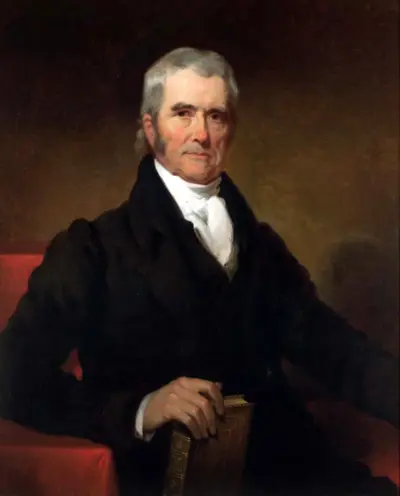
John Marshall was an American politician and lawyer who served as the fourth Chief Justice of the United States from 1801 to 1835. Marshall remains the longest-serving chief justice and fourth-longest serving justice in Supreme Court history, and he is widely regarded as one of the most influential justices to ever sit on the Supreme Court. Prior to joining the Supreme Court (and for one month simultaneous to his tenure as Chief Justice), Marshall served as the United States Secretary of State under President John Adams.
