John McLean Quotes
That distinct sovereignties could exist under one government, emanating from the same people, was a phenomenon in the political world, which the wisest statesmen in Europe could not comprehend; and of its practicability many in our own country entertained the most serious doubts. Thus far the friends of liberty have had great cause of triumph in the success of the principles upon which our government rests. But all must admit that the purity and permanency of this system depend on its faithful administration. The states and the federal government have their respective orbits, within which each must revolve. If either cross the sphere of the other, the harmony of the system is destroyed, and its strength is impaired. It would be as gross usurpation on the part of the federal government, to interfere with state rights, by an exercise of powers not delegated; as it would be for a state to interpose its authority against a law of the union.
John McLean, 1785-1861, U. S. Supreme Court Justice, U.S. Congressman (Whig, OH), U.S. Postmaster General, Presidential candidate for the Whig and Republican parties, Craig v. Missouri, 1830
Sourced by: Eigen's Political and Historical Quotations


At the time his Vice President, John C. Calhoun, was expounding a theory of “nullification” by which the states could supersede and nullify federal law in their states. When Jackson finished his toast, it was Calhoun’s turn (See {635896}.) His toast supported the States’ Rights position over the federal government. In those days Presidents and Vice President’s were often political enemies or of opposite parties. The President’s advisors thought that his toast might be misinterpreted. So when they gave the toast to the press as “The Federal Union: It must be preserved.” That was the form in which the press reported the President’s toast and for many years that was the version most quoted even though it was never delivered that way. However Jackson was responsible for both versions.


The Grammar Curmudgeon. In most states there is a parallel question of the State government and the local government balance of powers.


At the time most of the members of Congress were worried about the “General Government”—their term for the Federal Government---than they were, the state governments from which they had come and were in their minds represented. If would be almost a century before it was generally accepted that the States themselves must follow the Constitution and its amendments. Madison was way ahead of his time, and saw that rights must be protected from all levels of government.

A Bill of Rights was needed Left before it ended.


Madison was defending the proposed Constitution against a vocal minority who complained that the Federal government would be dominant over the States and the large cities. Madison pointed out that it was people who fought the Revolution and sacrificed for it, not States or political entities. The Constitution was to be for the people, not the existing governmental entities. It was for Americans and not for local politicians. The “State’s Rights faction lost the debate, and the Constitution and Bill of Rights was adopted. That is why this quotation is so important. The slavery enthusiasts, racists, and others have constantly tried to diminish the Federal supremacy even to this day.
The Vice President and the President were at odds over the theory of “nullification” by which the states could supersede and nullify federal law of action in their states. The President had just given a toast to the Preservation of the Union (See {587324}). So Calhoun embellished upon it and gave this toast. The President then strengthened the version of his toast that was given to the press so that it was clear that he did not support his Vice President’s position on nullicication.
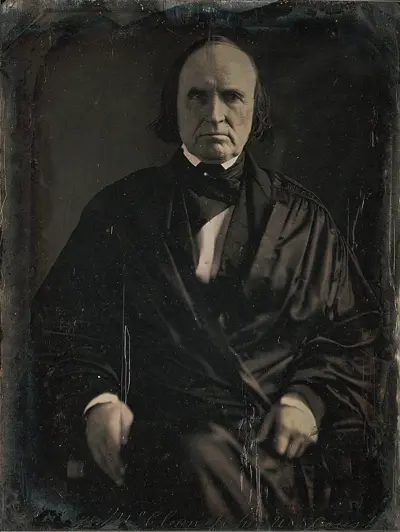
John McLean was an American jurist and politician who served in the United States Congress, as U.S. Postmaster General, and as a justice of the Ohio and U.S. Supreme Courts. He was often discussed for the Whig Party nominations for President.
