Edmund Gibson Ross Quotes
Conditions may, and are not unlikely to arise, some day, when the exercise of the power to impeach and remove the President may be quite as essential to the preservation of our political system as it threatened to become in this instance destructive of that system. Should that day ever come, it is to be hoped that the remedy of impeachment, as established by the Constitution, may be as patriotically, as fearlessly, and as unselfishly applied as it was on this occasion rejected..
He cast the deciding vote to acquit in the Andrew Johnson impeachment. He was the last of only 7 Republicans voting to acquit. His vote meant there would not be the required two/thirds of the Senate to vote in order to remove Johnson from office. His constituents were so angry with him that he was never reelected.
Edmund Gibson Ross, 1826–1907, U. S. Senator (Republican, KS), Governor of the New Mexico Territory, History of the Impeachment of Andrew Johnson …, 1896
Sourced by: Eigen's Political and Historical Quotations

The debate was about the unlimited pardon power of the President. Madison argued that the check was the impeachment power. However, Presidents had tended to make large numbers of pardons just before they leave office so the impeachment power works only as a check for the beginning and middle part of their term.

The convention turned down the constitution and would not ratify it until the Bill of Rights was passed later. By modern standards, Presidents in modern times have withheld much information from the Congress and in some cases such as the George W. Bush administrations, the President and his cabinet frequently lied to the Senate, the House, and the American people with no effort made to impeach. Based on the original intent of the Americans ratifying the Constitution, the Executive Branch may not keep anything material to the security of the country secret from Congress. But the center of both parties reject this regardless of what the original intent was.

Senator Grimes thought that Andrew Johnson was a terrible President, but when the House of Representatives impeached President Johnson and he was tried before the Senate, Grimes voted for acquittal. His reason for the his vote was he thought that the Constitution did not provide for the removal if a President just because he has “Unacceptable.” Johnson survived removal from office by a single vote and had Grimes not been so principled about the Constitution, Johnson would have been removed from office. On the other hand, Johnson was a terrible President and many of the nations racial problems in later years emanated from his actions and inactions while in office.


Hamilton pointed out that there is always a philosophical conflict between impeachment of an elected official and the right of the people to choose their own representatives. Both have very important and noble reasons supporting them. The founding fathers compromised by allowing impeachment, but making it very difficult.


The view that the Supreme Court was the final arbiter of constitutional controversies was not held in early America.

This notion seems to have first been expressed by Edward S. Corwin in 1940


The 534 he referred to were the Members of Congress.

Marshall is famous for, as Chief Justice, establishing the principle that the Judiciary can override Congress and the Executive in determining Constitutionality. However, as this quotation illustrates this principle had been discussed in open debate on the ratification of the Constitution. It was not simply a grab for power by a Chief justice; he uttered this quotation long before he ever suspected he would be a judge but actually spent much of his career in the executive and legislative branch of government.

Seven states was then a majority of the states.


The issue had first arisen during the Watergate Scandal, where there was concern that if the House held impeachment hearings of President Nixon, he might refuse to provide documents or order others in the Executive Branch not to testify. In this hearing, they were discussing the possible impeachment of President George W. Bush.
The Congress over the last century has ceded much of its Constitutional power to the President. Congress has much power to check the President, but just as Congress has not been very competent at legislating, oversight, and conducting hearings and investigations, it has not organized itself to use the powers it has very well.


Vidal, a staunch liberal held this view along with many ultra conservatives end extreme liberals. The constitution requires the Congress to declare war, but they have not done so for any of the wars since WWII. The President assumed the war power. And the only coherent budgets began.


In England, the King was above the law. However, impeachment was a tool that could be used against his favorite ministers. In debating the United State Constitution one of the first questions to be determined was whether impeachment could be a tool used against the President or like, England, only the other government officials. Franklin urged the President be included. See also Mason: {584246}.

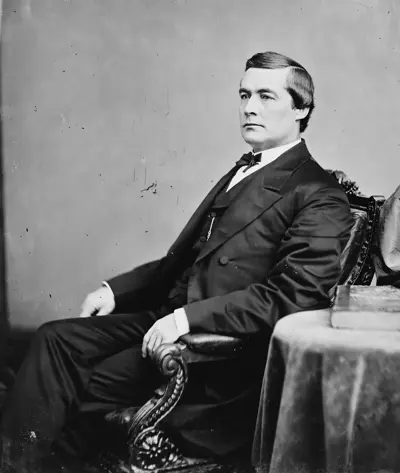
Edmund Gibson Ross was a politician who represented Kansas after the American Civil War and was later governor of the New Mexico Territory. His vote against convicting President Andrew Johnson of "high crimes and misdemeanors" allowed Johnson to stay in office by the margin of one vote. As the seventh of seven Republican U.S. Senators to break with his party, he proved to be the person whose decision would result in conviction or acquittal. When he chose the latter, the vote of 35–19 in favor of Johnson's conviction failed to reach the required two-thirds vote. Ross lost his bid for re-election two years later.
