Andrew Johnson Quotes
It is the President upon whom the Constitution devolves, as head of the executive department, the duty to see that the laws be faithfully executed; but as he cannot execute them in person, he is allowed to select his agents, and is made responsible for their acts within just limits. So complete is the presumed delegation of authority in the relation of a head of department to a President, that the Supreme Court of the United States have decided that an order made by a head of department is presumed to be made by the President himself.
Andrew Johnson, 1808-1875, 17th President of the United States (War Democrat), Statement in his defense relating to his Impeachment Trial
Sourced by: Eigen's Political and Historical Quotations


In England, the King was above the law. However, impeachment was a tool that could be used against his favorite ministers. In debating the United State Constitution one of the first questions to be determined was whether impeachment could be a tool used against the President or like, England, only the other government officials. Franklin urged the President be included. See also Mason: {584246}.


The debate was about the unlimited pardon power of the President. Madison argued that the check was the impeachment power. However, Presidents had tended to make large numbers of pardons just before they leave office so the impeachment power works only as a check for the beginning and middle part of their term.

In England, the King was above the law. However, impeachment was a tool that could be used against his favorite ministers. In debating the United State Constitution one of the first questions to be determined was whether impeachment could be a tool used against the President or like, England, only the other government officials. Mason argued that the President must be included and his view prevailed. See also Benjamin Franklin: {642885}.

The convention turned down the constitution and would not ratify it until the Bill of Rights was passed later. By modern standards, Presidents in modern times have withheld much information from the Congress and in some cases such as the George W. Bush administrations, the President and his cabinet frequently lied to the Senate, the House, and the American people with no effort made to impeach. Based on the original intent of the Americans ratifying the Constitution, the Executive Branch may not keep anything material to the security of the country secret from Congress. But the center of both parties reject this regardless of what the original intent was.

This article of impeachment is quoted often because it shows that criminal activity or violation of a law was not required for impeachment. The time was close to the adoption of the Constitution and presumably reflected sentiment of the founders. Chase however was acquitted as the Senate did not agree that the charges had been proven.
President Thomas Jefferson himself forwarded to the House some of the evidence against Pickering, the first Federal Judge to be removed by impeachment.

President George W. Bush had ignored a federal law and tapped the phones of Americans without probable cause and a warrant issued by a court. The President’s defenders argued that the President, as Commander in Chief, has the Constitutional responsibility to lead the military and protect the nation. Intelligence gathering is part of military activity. Therefore the intelligence gathering is a Constitutional duty and the Congress, under the separation of powers doctrine, may not interfere with the President’s Constitutional Duty to conduct intelligence. Under this doctrine, the President need not obey laws that he believes impinge on his management of the war effort and the defense of the nation. Most legal scholars believe that this argument is nonsense, but the George W. Bush administration has stated the doctrine and it was the subject of much litigation.


The reason that this quotation is particularly important is that Taft, in addition to being a President, was also the Chief Justice of the Supreme Court, the only Supreme Court Justice to become President.

The convention turned down the constitution and would not ratify it until the Bill of Rights was passed later.


The view that the Supreme Court was the final arbiter of constitutional controversies was not held in early America.

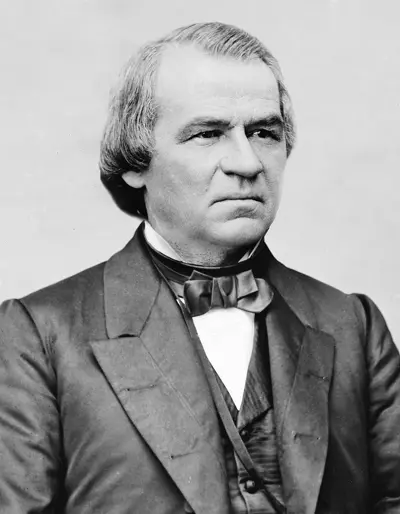
Andrew Johnson was the 17th president of the United States, serving from 1865 to 1869. He assumed the presidency as he was vice president at the time of the assassination of Abraham Lincoln. Johnson was a Democrat who ran with Lincoln on the National Union ticket, coming to office as the Civil War concluded. He favored quick restoration of the seceded states to the Union without protection for the former slaves. This led to conflict with the Republican-dominated Congress, culminating in his impeachment by the House of Representatives in 1868. He was acquitted in the Senate by one vote.
