Andrew Johnson Quotes
I am a Union man!
The then Vice President was accosted on the train by southerners who believed that he was on his way to his home state of Tennessee to persuade the legislature not to secede from the union. Amid cries to hang him and after he was punched by one of the mob, ex-Senator Wigfall—the man who had received the surrender sword at Sumter, who was also on the train, persuaded the crowd to hear Johnson out. Johnson thus began his speech which was potentially for his life, but never wavered from his view that secession was a mistake. Most of the crowd calmed down and as the train pulled out, they let him go though there were still a few shouts for “hanging.” There was no secret service protection for the President or vice President at the outbreak of the Civil War. Pinkerton had organized some informal protection for the President and thwarted some plots, but it was the Vice President who was attacked first. And there was not sufficient protection to prevent Lincoln’s assassination.
Andrew Johnson, 1808-1875, 17th President of the United States (War Democrat), Statement to a mob which had attacked him just after the fall of Fort Sumpter, Alexandria, VA railroad station
Sourced by: Eigen's Political and Historical Quotations


The unions that broke off were very successful at increasing union membership and made large efforts at organizing. The others were losing members for the most part and devoted most of their resources to politics to protect what they had.


Sadova was a major battle where the Prussians defeated the Austrians. It was known to all Germans as historically key to developing a German nation.


War had broken out in Europe and Jefferson enumerated a series of actions so that the United States would remain neutral. He was concerned that individual Americans would partake in foreign wars and then be captures of have to be ransomed or would give offence to some other nation who would assume that the American was acting with government approval and was allied with an enemy. The issue of American mercenaries fighting in foreign conflicts has been controversial ever since.
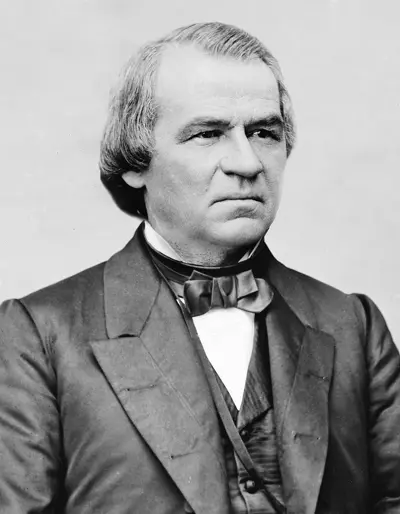
Andrew Johnson was the 17th president of the United States, serving from 1865 to 1869. He assumed the presidency as he was vice president at the time of the assassination of Abraham Lincoln. Johnson was a Democrat who ran with Lincoln on the National Union ticket, coming to office as the Civil War concluded. He favored quick restoration of the seceded states to the Union without protection for the former slaves. This led to conflict with the Republican-dominated Congress, culminating in his impeachment by the House of Representatives in 1868. He was acquitted in the Senate by one vote.
