Alexander the Great Quotes
Holy shadows of the dead, I’m not to blame for your cruel and bitter fate, but the accursed rivalry which brought sister nations and brother people, to fight one another. I do not feel happy for this victory of mine. On the contrary, I would be glad, brothers, if I had all of you standing here next to me, since we are united by the same language, the same blood and the same visions.
Alexander III (‘The Great’) 356-323 BC, King of Macedonia, Speech to the dead Athenian and Thebean Greeks at the Battle of Chaeronea, 338 BC, Quoted in Quintus Rufus, Historiae Alexandri Magni
Sourced by: Eigen's Political and Historical Quotations


The then Vice President was accosted on the train by southerners who believed that he was on his way to his home state of Tennessee to persuade the legislature not to secede from the union. Amid cries to hang him and after he was punched by one of the mob, ex-Senator Wigfall—the man who had received the surrender sword at Sumter, who was also on the train, persuaded the crowd to hear Johnson out. Johnson thus began his speech which was potentially for his life, but never wavered from his view that secession was a mistake. Most of the crowd calmed down and as the train pulled out, they let him go though there were still a few shouts for “hanging.” There was no secret service protection for the President or vice President at the outbreak of the Civil War. Pinkerton had organized some informal protection for the President and thwarted some plots, but it was the Vice President who was attacked first. And there was not sufficient protection to prevent Lincoln’s assassination.


The “mystic chords of memory” which is one of the most famous Lincoln phrases. As great as this address was, it did not succeed in its purpose of maintaining the Union and preventing secession.

Resolutions were introduced to expel Robert M. La Follette from the Senate for his unpopular anti-war views.

The irony was that it was by warfare that he conquered most of the Hawaiian Islands and formed them into a kingdom.

The Vietnam War was raging and the country was polarized by it. The real issue of the time, as we were in the war, was whether we could better obtain peace by winning victories in the field causing the enemy to want to negotiate or to withdraw and produce peace unilaterally. In the end we tried a little of both reflecting the division in the nation. We succeeded at neither strategy and the polarization continued for many decades.

Eisenhower was then Supreme Allied Commander.


The North and the South had major differences on the issue of Spanish Florida and whether or not the U. S. should expand by force. Northerners were generally opposed while the South had an opposite view.

Builder of over 90 percent of the U. S. Navy World War II Boats
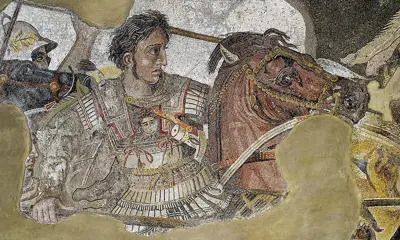
Alexander III of Macedon, commonly known as Alexander the Great, was a king (basileus) of the ancient Greek kingdom of Macedon and a member of the Argead dynasty. He was born in Pella in 356 BC and succeeded his father Philip II to the throne at the age of 20. He spent most of his ruling years on an unprecedented military campaign through Western Asia and Northeastern Africa, and by the age of thirty, he had created one of the largest empires in history, stretching from Greece to northwestern India. He was undefeated in battle and is widely considered one of history's most successful military commanders.
